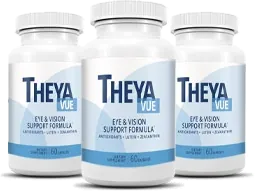
Guides and deeper reading
This hub links every long-form page on the site: the AREDS2 Explained and Supplements and Lab Tests guides, three blog posts on the panel's arithmetic, lutein research and red-flag claims, and the ten deep pages covering ingredients, dosing, safety and results.
Everything longer than a product page, in one place
Three kinds of page live on this site, and they answer different questions. Product pages describe this specific bottle: what is on the panel, what it costs, how to take it. The two guides below step back from the bottle entirely and explain a topic on its own terms. The blog sits in between: shorter, single-focus posts that each take one number or one claim and work through it.
This page is the map. Every guide, every post and every deep page on this site is linked from here, in one place, so you never have to hunt for the page that actually answers what you came to ask.
None of these pages exist to sell you anything harder than the product pages already do. They exist because a fair answer to "does AREDS2 back this up" or "why did my lab result look strange" takes more than a paragraph buried under a buy button, and a short answer squeezed onto a product page tends to lose the parts that matter most.
Our two long-form guides
AREDS2 Explained
The National Eye Institute trial that every eye supplement, including this one, gets measured against. What it tested, who it was tested in, and the difference between slowing a disease that is already there and sharpening vision that has not changed. It is the guide behind every AREDS2 comparison on this site.
Read the guide →Supplements and Lab Tests
Why a supplement bottle can quietly change what a blood test reports, using biotin's effect on troponin and thyroid assays as the clearest example. What to tell a clinic before bloodwork, and why the warning applies to more than just this product.
Read the guide →The AREDS2 guide exists because the trial gets invoked, directly or by implication, on almost every eye supplement page on the internet. Age-Related et al., 2013 and National Eye Institute (NEI), 2025 both describe a formula tested in people who already had intermediate or advanced macular degeneration, not a formula tested for sharpening healthy eyesight. Confusing those two populations is the single most common way an eye supplement page misleads without printing a single false number.
The lab-tests guide exists for a narrower but very concrete reason: U.S. et al., 2022 documents biotin interfering with certain blood tests, including cardiac troponin, badly enough that the FDA published a list of affected assays. A supplement bottle rarely comes with a warning sticker for the lab, so that guide is the sticker.
Why a blog sits next to the guides

The blog exists for the claims and the arithmetic that need more room than a product page can spare. A product page has to cover the whole bottle. A blog post can spend its entire length on one number, one ingredient or one sentence from a sales page, and follow it all the way through.
Read the three posts below in any order. None of them assumes you have read the others first, and none of them requires reading a guide beforehand either. Each one is built to stand on its own, with its own sources linked at the point they matter rather than collected at the bottom for skimming past.
From the blog
Per Capsule Versus Per Day
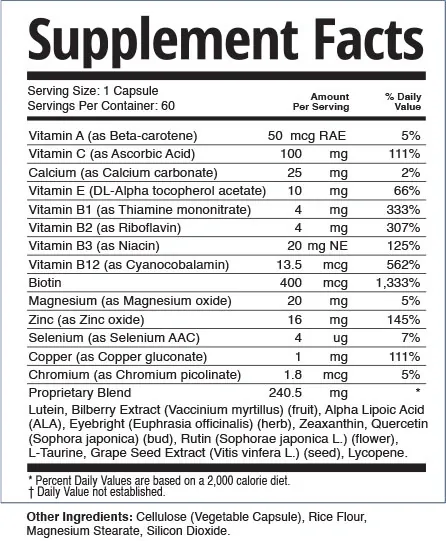
The single fact that shapes this whole site: the Supplement Facts panel is written per capsule, and the directions ask for two. What that does to every percentage on the label, and why a 60-capsule bottle is a 30-day bottle.
Read the post →What Lutein Actually Does
Lutein is named on the front of the bottle and given no amount on the back. What the research on lutein and macular pigment actually measured, over what timeline, and why this label's silence on dose makes it impossible to check against that research.
Read the post →Claims That Should Stop You
A short list of phrases that mean a sales page has stopped describing a supplement and started describing a miracle: restored 20/20 vision, thrown-away glasses, a reversed diagnosis. What to do the moment you see one.
Read the post →The lutein post leans on the same meta-analysis cited on the results timeline page, Wilson et al., 2021, which pooled 46 studies and found the size of any measured change depended heavily on the dose taken. That is the exact number this label declines to publish, which is the whole tension the post works through.
The claims post leans on Federal et al., 2005, a real FTC enforcement action against an eye-supplement marketer for advertising vision restoration and disease treatment it could not support. That case is a useful yardstick: any current sales page making a similar promise is not a new problem, it is an old one repeating.
Two ways to use this list
Still deciding whether to order
Ingredients, How It Works, Benefits and Supplement Facts answer what is actually in the bottle and what the research behind each part supports, before any money changes hands.
Already own a bottle
How to Use, Side Effects, Results Timeline, Testing & Quality and Batch Verify answer the questions that come up after the box is open: how to take it, what to watch for, and what a fair timeline looks like.
Every deep page on this site
| Page | What it covers |
|---|---|
| Ingredients | Every one of the fourteen measured nutrients and the ten inside the blend, with a research dose and a safety note for each. |
| How It Works | What each part of the panel is meant to do in the body, and what none of it is shown to do for eyesight. |
| Benefits | The support claims on the front and back of the bottle, checked one by one against real research. |
| Supplement Facts | The panel decoded line by line, per capsule and per day, side by side. |
| Who It's For | Who this product suits, who should talk to a clinician first, and who should not take it at all. |
| How to Use | Dosing, timing before meals, a missed dose, why never to double up, and storage. |
| Side Effects | Every caution this label raises, from the niacin limit to biotin's effect on lab tests, each with its source. |
| Results Timeline | What week 1, weeks 8-12 and your next eye exam can and cannot show, and why that outruns the refund window. |
| Testing & Quality | The seals printed on the bottle, and exactly what each one does and does not verify. |
| Batch Verify | How to check the lot and CoA reference on your own bottle against what we were given. |
These are the pages that stay specific to this one bottle. If the guides and the blog are the reasoning, this list is the bottle itself, taken apart one section at a time.
Where to start
Not sure where to start? If you already own a bottle, how to use it and the side effects page matter most. If you are still deciding, AREDS2 Explained and the ingredients page are the fastest way to see what you would actually be buying.
Every page linked from this hub was written the same way: the panel outranks the sales page, a gap in the paperwork gets marked as a gap instead of filled in with a guess, and every study gets a link back to where it came from. That standard does not change from a guide to a blog post to a deep page. Anything else, the order desk answers at +1 (315) 724-2018.
Guides: common questions
What is the difference between a guide and a blog post?
A guide covers a whole topic on its own terms, such as the AREDS2 trial or lab-test interference. A blog post is shorter and stays on one number or one claim, such as the per-capsule-versus-per-day arithmetic.
What is the difference between a guide and a deep page?
A guide can apply to eye supplements generally. A deep page, like Ingredients or Side Effects, is specific to this one bottle's panel and directions.
Do the guides cover TheyaVue specifically?
They explain the background TheyaVue is measured against, such as the AREDS2 formula, and link back to where that background applies to this label.
Is AREDS2 the same product as TheyaVue?
No. AREDS2 is a National Eye Institute trial formula, not a product. TheyaVue's own amounts are compared against it on the AREDS2 Explained guide and on the ingredients page.
Why does a supplement site have a guide about lab tests?
Because biotin, an ingredient in this product, can skew certain blood test results. The guide explains why and what to tell a clinic before bloodwork.
Where should I start if I am new to this site?
AREDS2 Explained and the ingredients page give the fastest overall picture. How to Use and Side Effects matter most once you already own a bottle.
Are the guides sponsored by TheyaVue?
No. Mytheyavue is a U.S. stocking partner and earns money on purchases, but the guides are written from the research and the label, not from marketing copy.
How often is this page updated?
Whenever a guide, post or deep page is added or revised. The date at the bottom of the page reflects the most recent check.
Keep reading
TheyaVue FAQ
Every common question about the label, dosing, safety and refunds, grouped in one place.
Read →TheyaVue ingredients
Every ingredient on the panel, one by one, with its research dose and safety note.
Read →TheyaVue kits and pricing
What the three kit sizes cost, and how many days each one actually covers.
Read →Order TheyaVue from the authorized retailer
60 servings per bottle, 1 to 2 droppers a day. Kits of 2, 3 or 6 bottles run from $39 a bottle on the sales page, with a 60-day money-back guarantee. Questions first? Call +1 (315) 724-2018.