Per Capsule vs. Per Day: Reading a TheyaVue Label Right
TheyaVue's panel lists Serving Size as one capsule, but the directions ask for two a day, so every printed percentage is half the real daily amount and the 60-capsule bottle lasts 30 days, not 60. Manufacturers can legally set Serving Size below the recommended daily amount. Check the Directions line first, multiply by the real daily count, then re-price the bottle from there.
Why a bottle can print two true numbers that mean different things
Pick up almost any supplement bottle and you will find two separate pieces of text that rarely sit near each other. One is the Supplement Facts panel, a small printed table with a "Serving Size" line at the top. The other is the Directions or Suggested Use line, usually lower on the label or on the side panel, telling you how many capsules to actually take and how often.
On TheyaVue, those two pieces of text describe the same bottle in two different units. The panel counts one vegetable capsule as a serving. The directions ask for one capsule twice a day. Both statements are true. Read only the panel and you will walk away thinking the bottle is stronger, and lasts longer, than it does.
This is not a claim that anything on the panel is false. Every number printed there is accurate for the unit it describes. The problem is that most shoppers assume a Supplement Facts panel already reflects a day’s dose, the way a nutrition label on a cereal box usually does. On a twice-daily capsule, it does not, and the gap between the two readings is exactly double.
What "Serving Size" and "Servings Per Container" legally mean
"Serving Size" and "Servings Per Container" are not casual phrases. They are specific fields that federal labeling rules require on every Supplement Facts panel, and the manufacturer, not the government, chooses what a serving is.
| Line on the panel | What it literally states | What it does not require |
|---|---|---|
| Serving Size | The unit the maker has chosen to describe, most often one capsule, tablet or scoop | It does not have to equal a full day’s recommended amount |
| Servings Per Container | Total units in the container divided by the serving size | It does not have to equal the number of days the bottle will last you |
| % Daily Value | The share of a recommended daily intake provided by one serving as defined above | It does not update itself if the directions ask for more than one serving |
A manufacturer is free to define a serving as one capsule even when the directions on the very same bottle ask for two. Nothing in the rule ties the chosen serving size to the recommended daily amount; it only has to be a realistic unit of the product. That is the legal room this whole mismatch lives in.
The practical result: the Servings Per Container number tells you how many capsules are in the bottle, divided by one. It does not tell you how many days the bottle covers once you follow the directions. Those are two different counts that happen to share a label.
Why a per-capsule panel quietly halves every percentage you read
Once a panel is written per single capsule, every percentage on it is anchored to that one capsule. Take two, as directed, and you are getting double each number shown, with nothing on the panel itself flagging that fact.
This matters most for the entries already running high on a per-capsule basis. Niacin is measured against a 35 mg daily upper limit set for the supplemental form, a limit the National Institutes of Health bases on the flushing reaction some people get from it (National Institutes of Health, 2022). Biotin does not have an upper limit, but the Food and Drug Administration has separately warned that biotin can distort common lab tests, including troponin and thyroid panels, and has published a list of assays known to be affected (U.S. et al., 2022).
A percentage under 100% on a per-capsule line can cross into triple digits once it is doubled for the real daily dose. Nothing about that is hidden or illegal. It is simply not shown anywhere on the printed panel, because the panel was never written in the unit you actually take.
None of this means the ingredient amounts themselves changed. It means the shopper doing quick mental math from the panel alone, the way most people size up a bottle in a store aisle, is working from half the real number without knowing it.
TheyaVue’s own panel, worked out both ways
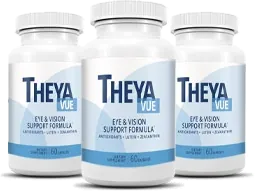
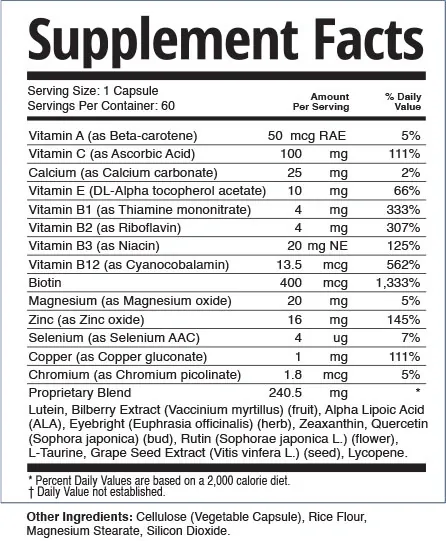
TheyaVue’s own bottle is a clean example, because the mismatch is easy to check against the printed directions rather than a guess. The bottle holds 60 vegetable capsules. The Supplement Facts panel counts "Serving Size: 1 capsule" and "Servings Per Container: 60." The directions on the same label ask for one capsule twice daily.
| Nutrient | Per capsule (panel column) | % DV per capsule | Per day at the labeled dose |
|---|---|---|---|
| Vitamin C (as Ascorbic Acid) | 100 mg | 111% | 200 mg |
| Vitamin B3 (as Niacin) | 20 mg NE | 125% | 40 mg NE |
| Biotin | 400 mcg | 1,333% | 800 mcg |
| Zinc (as Zinc oxide) | 16 mg | 145% | 32 mg |
| Proprietary Blend | 240.5 mg | † | 481 mg |
Read only the left-hand columns and the bottle looks like a 60-day supply carrying modest percentages. Read the right-hand column, which matches what the directions actually ask you to swallow, and the picture changes: the bottle is a 30-day supply, and every one of those percentages doubles.
The full panel, including the fourteen individually measured nutrients and the 240.5 mg blend that sits behind it, is broken down line by line on the Supplement Facts page, with both columns shown side by side.
How to spot this on any bottle before you buy it
Find the Directions line before you look at the panel
It is usually printed separately from the Supplement Facts box, sometimes on a different face of the label. Read it first so you know the real daily count going in.
Compare that count to the panel’s Serving Size
If Directions says "two capsules daily" and the panel says "Serving Size: 1 capsule," you already know every number on the panel needs doubling to describe your day.
Multiply, don’t assume
Take the per-capsule amount and the per-capsule % Daily Value and multiply both by however many capsules the directions ask for in a day. Do this for at least the highest percentages on the panel.
Divide the capsule count by your real daily dose, not by one
A 60-capsule bottle taken two at a time lasts 30 days, not 60. Divide the total capsule count by your actual daily number to get the true days-supply.
Recheck anything already near a published limit
A percentage that looks moderate per capsule can cross a Daily Value, or a separate safety limit, once doubled. That is worth a second look before you buy multiple bottles.
What it does to cost-per-day and days-per-bottle math
| Kit | Capsules | Real days at two a day | Total price | True cost per day |
|---|---|---|---|---|
| 1 Bottle | 60 | 30 | $59 | $1.97 |
| 3 Bottles | 180 | 90 | $147 | $1.63 |
| 6 Bottles | 360 | 180 | $234 | $1.30 |
Every one of those figures depends on using 30 days per bottle, not 60. A shopper who divided price by "servings per container" instead of by real days-supply would land on a cost-per-day roughly half of the true number, for every kit size, because the servings count and the days count are not the same thing here.
The same arithmetic applies to the refund window. 60 days from purchase, measured on a calendar, covers exactly two bottles at the real dose, not four. A shopper working from the servings-count assumption might expect the guarantee to stretch further into a larger kit than it actually does. More on that trade-off is on the pricing page and the guarantee page.
A short checklist for the next label you read
None of this arithmetic requires a calculator app or a chemistry background. It requires reading the Directions line and the Serving Size line as two separate facts, and doing one multiplication before you compare a price to a percentage.
- Read the Directions or Suggested Use line before the Supplement Facts panel, not after
- Note how many units the directions ask for in a day, separate from what the panel calls one serving
- Multiply every percentage you care about by that daily count before judging whether it looks high or low
- Divide the total unit count by your real daily dose to get true days-per-bottle, then re-price per day from there
- Treat a mismatch between Serving Size and Directions as a normal, legal labeling choice, not a red flag on its own, but always redo the math before comparing bottles
TheyaVue’s panel happens to be per capsule for a twice-daily product, which is what makes it a clean teaching example. It is far from the only bottle built this way. The habit worth keeping, on any supplement aisle: read the directions first, then let the panel answer to that number rather than the other way around. For how this same panel lines up against the National Eye Institute’s AREDS2 eye formula once the doubling is accounted for, see our AREDS2 walkthrough, and for what the front-of-bottle ingredients actually deliver, see what lutein actually does.
Questions readers ask
Is it legal for a Supplement Facts panel to be written per capsule on a twice-daily product?
Yes. Federal labeling rules let the manufacturer choose the Serving Size, and nothing requires it to match the number of units the directions recommend per day.
Why does this make every percentage on the panel misleading at a glance?
It doesn't make them false, only incomplete. Each percentage is correct for one capsule. Reading it as a day's amount, without checking the directions, understates the real intake by half on a twice-daily product.
How many days does a 60-capsule TheyaVue bottle actually last?
Thirty days. The panel counts 60 servings of one capsule each, but the directions ask for two capsules a day, so 60 capsules divide into 30 daily doses.
What's the fastest way to check this on a bottle I already own?
Find the Directions line, note the daily capsule count, then compare it to the Serving Size printed at the top of the Supplement Facts panel. If they differ, multiply every percentage you care about by the ratio between them.
Does doubling the panel numbers mean the product is unsafe?
Not automatically, but it can push a number that looked moderate per capsule past a published limit once doubled, which is worth checking rather than assuming.
Why do cost-per-day figures change once you account for this?
A price divided by the Servings Per Container count, instead of by the real days-supply, understates the true cost per day, because the servings count and the days count are not the same number on a multi-capsule-per-day product.
Does this pattern show up on products other than TheyaVue?
It is common across the supplement category whenever directions call for more than one unit a day. TheyaVue's panel is used here because its own directions make the real daily dose easy to check against the printed one.
Where can I see TheyaVue's full panel broken down this way?
The Supplement Facts page lists every nutrient on the panel with both the per-capsule and per-day columns side by side, plus the 240.5 mg blend behind the front-label claims.
Keep reading
Claims that should stop you
Eye-supplement red flags: restoration promises, trick framing, invented doctors, before-and-after charts, testimonials, ...
Read →What lutein actually does
What lutein and zeaxanthin are, macular pigment, food sources, the AREDS2 dose, and why naming lutein with no amount tel...
Read →How much does TheyaVue cost?
Pack sizes, days of supply and how to pick the right one.
Read →Order TheyaVue from the authorized retailer
60 servings per bottle, 1 to 2 droppers a day. Kits of 2, 3 or 6 bottles run from $39 a bottle on the sales page, with a 60-day money-back guarantee. Questions first? Call +1 (315) 724-2018.