What TheyaVue's seals verify, and what they don't
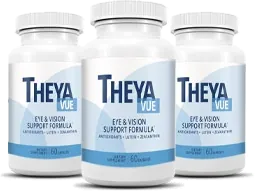
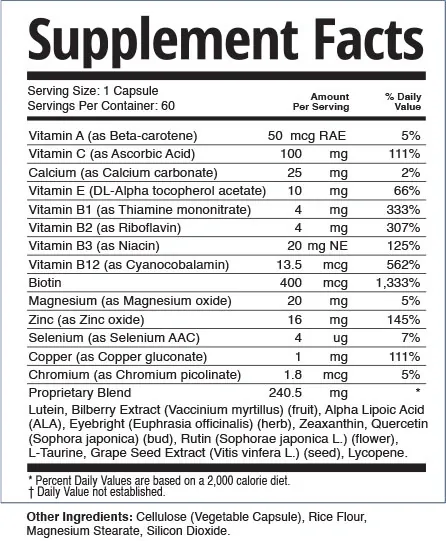
TheyaVue's packaging carries eight marks. FDA Registered Facility is a factory listing, not an approval. No GMP certificate number or auditor is published, no clinician is named behind 'Doctor Developed', and the panel names no manufacturer or distributor at all. No third-party lab report was provided, so lutein and zeaxanthin content, advertised on the front, remains unmeasured.
The eight marks on TheyaVue's packaging
FDA Registered Facility
The plant is on the FDA facility register. Registration is a listing, not an approval, and TheyaVue is not FDA-approved.
GMP Certified
Good Manufacturing Practice rules are claimed for the plant. No certificate number or auditing body is printed beside the mark.
Non-GMO
A non-GMO mark used in the seller artwork. No certifying organisation is named next to it.
Vegetarian
The shell is cellulose, a plant material, which matches a vegetarian claim. No certifier is named.
Gluten Free
A gluten-free mark from the artwork. The panel prints no allergen statement and no parts-per-million threshold.
Dairy Free
A dairy-free mark from the artwork, again with no allergen line on the panel itself.
Doctor Developed
A marketing mark. No clinician is named anywhere in the material we were given, so treat it as unverified.

60-Day Money Back
A purchase promise from the sales page, not a health promise. Return postage is on the buyer.
Eight marks appear in the seller artwork for this product. Each one is a real design element on the packaging, and each one describes something narrower than it looks. Read each mark below the same way you would read the ingredient panel: for what it actually says, not for what a badge shape suggests.
What FDA Registered Facility actually means
Registering a facility with the FDA means the plant told the agency it exists and what it makes there. It is closer to filing paperwork than to passing an inspection with a grade attached. The FDA does not review or approve individual dietary supplement formulas before they reach a shelf, and TheyaVue is not, and cannot be, "FDA-approved" as a result of this mark.
A registered facility can still make products of very different quality. Registration tells you the plant is on a list. It does not tell you what happened inside it on the day this particular lot was filled.
What GMP Certified actually means
Good Manufacturing Practice covers things like clean equipment, trained staff and consistent recordkeeping. A real GMP audit produces a certificate: a number, an issuing or auditing body, and a date the audit covered. None of those three appear next to this mark in the material we hold for TheyaVue. We are not saying the audit did not happen. We are saying the mark alone gives us no way to check that it did.
If you want to verify a GMP claim on any supplement, the certificate number and the auditing body's name are the two things to ask for. A seller who can produce both has something checkable. A seller who cannot is asking you to take the mark on its own word.
Why the difference between 'claimed' and 'checkable' matters here
Both marks can be true and still tell you little
A facility can be registered with the FDA and also be GMP certified, and both of those things can be entirely accurate, while still leaving open exactly what happened during the production run that filled your specific bottle. Neither mark is a per-batch check.
A missing number is a question, not an accusation
We are not saying the GMP claim is false. We are saying that without a certificate number and an auditor's name, neither we nor you have a way to confirm it independently, which is a different statement from calling it untrue.
The other six marks, one by one
| Mark | What it tells you | What is missing |
|---|---|---|
| Non-GMO | The formula is presented as free of genetically modified ingredients | No certifying organization is named next to the mark |
| Vegetarian | The capsule shell is cellulose, a plant material, consistent with this claim | No certifier is named; the panel prints no separate allergen statement |
| Gluten Free | The product is presented as free of gluten | No parts-per-million threshold or testing body is stated |
| Dairy Free | The product is presented as free of dairy | The panel itself carries no allergen line to back up the artwork claim |
| Doctor Developed | A clinician is implied to have had a role in the formula | No clinician is named anywhere in the material we were given |
| 60-Day Money Back | A purchase promise from the seller | It is a retail term, not a health claim or a measure of quality |
Why we won't name a doctor behind this mark
"Doctor Developed" is a phrase, not a credential. It appears on the packaging without a name, a specialty or a license number attached anywhere in the material we hold. We will not invent a doctor to put behind it, and we will not describe the formulation process as clinician-led when nothing in front of us names one.
A genuine claim of this kind is checkable: a real name, searchable credentials, and ideally a statement of what that person actually did, whether that was choosing ingredients, setting amounts or reviewing a finished label. None of that accompanies this mark, so we treat it as marketing language and nothing more.
No manufacturer or distributor is named anywhere on the panel
The panel image we were given carries no manufacturer name, no distributor address and no country of manufacture, anywhere on it. That is unusual. Most supplement labels print at least a distributed-by line, even when the actual factory is a separate contract manufacturer working under that brand.
We are flagging the absence rather than filling it in with a guess. If you want that information, the order desk is the direct route: call +1 (315) 724-2018 and ask. We would rather send you to a phone call that might get a real answer than print a name we cannot verify.
Every other place this panel stays quiet is listed together on the Supplement Facts page.
What third-party testing would look like, if it existed here
None of this is unusual to ask for. Plenty of supplement brands publish exactly this, batch by batch. TheyaVue's material does not.
| What real third-party testing would show | What we have instead |
|---|---|
| A named, accredited lab, checkable independently | No lab named |
| A batch-specific report tied to the lot in your hand | Not provided |
| A measured amount for lutein and zeaxanthin, not just the 240.5 mg blend total | Not published |
| Heavy metal results (lead, arsenic, cadmium, mercury) against a stated limit | Not provided |
| Microbial results (yeast, mold, bacteria) against a stated limit | Not provided |
| A public way to look up the report by lot number | Not available |
Why carotenoid content, specifically, is worth verifying
Carotenoid content is worth verifying for a specific reason: the amount is the entire question. Lutein and zeaxanthin are named on the front of this bottle, and both sit inside the 240.5 mg blend with no individual amount printed. A pooled analysis of 46 studies found intakes below 5 mg a day produced no measurable change in macular pigment over three to six months, while intakes of 20 mg a day or more produced a larger change than intakes in between Wilson et al., 2021. Whether this product sits above, below or inside either range cannot be answered from the label alone.
A potency assay, the kind a real certificate of analysis reports, would answer that question directly: a measured milligram figure for lutein and a separate one for zeaxanthin, tested from an actual capsule rather than assumed from the ingredient list's order. Until that number exists and is published, "advertised on the front, unmeasured on the back" is the accurate description of where this stands. More on what a real certificate contains is on the batch verification page, and the full blend list is on the ingredients page.
Testing & Quality: common questions
Is TheyaVue FDA-approved?
No. FDA facility registration is a listing, not a product approval, and dietary supplements are not FDA-approved as a category.
What does GMP Certified actually guarantee?
It claims manufacturing standards were followed. No certificate number or auditing body is published alongside the mark, so the claim cannot be independently checked from this material.
Who is the doctor behind 'Doctor Developed'?
No clinician is named anywhere in the material we hold. We treat the phrase as a marketing mark, not a credential.
Why doesn't this page name the manufacturer?
The panel we were given prints no manufacturer name, distributor address or country of manufacture. We flag that gap rather than guess at it.
Has TheyaVue been third-party tested?
No published, named, batch-specific lab report was provided to us. See the batch verification page for what a real certificate would need to contain.
Why does the carotenoid amount matter so much?
Lutein and zeaxanthin are advertised on the bottle front but share one unmeasured blend total on the back, and research shows the amount taken changes the measurable effect.
Are the Non-GMO, Gluten Free and Dairy Free marks certified?
No certifying body is named next to any of the three in the material we hold, and the panel prints no separate allergen statement.
Keep reading
The batch and CoA numbers, checked honestly
Why lot THE-26/MY-1753 is a reference, not lab proof, and what a real certificate would contain.
Read →Every ingredient, inside and out
The fourteen itemised nutrients and the ten sharing the 240.5 mg blend.
Read →Reading the Supplement Facts panel
Everything printed, and everything the panel stays quiet about, line by line.
Read →Order TheyaVue from the authorized retailer
60 servings per bottle, 1 to 2 droppers a day. Kits of 2, 3 or 6 bottles run from $39 a bottle on the sales page, with a 60-day money-back guarantee. Questions first? Call +1 (315) 724-2018.