AREDS2 explained: the trial behind every eye formula
AREDS2 was a National Eye Institute trial in 4,203 people who already had intermediate or advanced macular degeneration. Its daily formula was vitamin C 500 mg, vitamin E 400 IU, lutein 10 mg, zeaxanthin 2 mg, zinc 80 mg (or 25 mg), and copper 2 mg. It slowed disease progression in that group. It did not sharpen vision and showed no benefit for early or no AMD.
Why an eye-supplement site needs a trial explainer
Two letters and a number, "AREDS2," show up on more eye-supplement bottles and pages than almost anything else in this category, usually without saying who ran it, who was actually enrolled, or what it found. This guide is the missing context: the trial itself, spelled out, so that any bottle claiming a connection to it, including this one, can be checked against the real study instead of against a marketing summary of it.
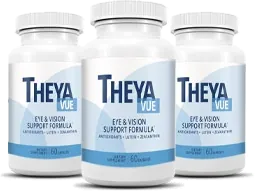
We wrote this because TheyaVue's own pages compare its label to AREDS2 repeatedly, and a fair comparison needs the trial explained once, in full, rather than referenced in fragments across a dozen pages.
Who actually ran AREDS2
AREDS2, the second Age-Related Eye Disease Study, was run by the National Eye Institute, part of the National Institutes of Health, the U.S. government's own vision-research agency. It was a large, multi-center, randomized, double-blind, placebo-controlled clinical trial, the same design standard used to approve prescription drugs, not an internet survey or a company-funded pilot study Age-Related et al., 2013.
That matters for reading any claim about it. A trial run by a supplement seller, testing its own formula, carries an obvious incentive to find a positive result. AREDS2 was designed, run and published independently of any single supplement brand, and its results apply to the specific formula tested, not to whichever bottle happens to cite it afterward.
Who was actually enrolled, and who was not
AREDS2 enrolled 4,203 people, ages 50 to 85, who already had intermediate age-related macular degeneration in both eyes, or advanced AMD in one eye with intermediate AMD or worse in the other. Every participant walked into the trial with a diagnosis already on their chart Age-Related et al., 2013.
Nobody with healthy eyes and no AMD was enrolled. Nobody with only early AMD, the mildest stage, was enrolled either. The trial answers one specific question: does this formula help slow things down in people who already have a meaningful amount of macular degeneration? It was never built to answer whether the formula prevents AMD in someone who does not have it yet, or improves sight in someone with early disease.
The National Eye Institute's own patient-facing page is direct about this scope: the formula "may help slow" progression in people who already have intermediate or advanced AMD, or who have lost vision in one eye to it, and NEI states plainly that AREDS data showed no benefit for people without AMD or with only early AMD National Eye Institute (NEI), 2025.
The exact daily formula the trial tested
| Nutrient | AREDS2 daily amount | Chemical form used in the trial |
|---|---|---|
| Vitamin C | 500 mg | Ascorbic acid |
| Vitamin E | 400 IU (about 180 mg) | Alpha-tocopherol |
| Lutein | 10 mg | Free lutein |
| Zeaxanthin | 2 mg | Free zeaxanthin |
| Zinc | 80 mg (25 mg in a second arm) | Zinc oxide |
| Copper | 2 mg | Cupric oxide |
That table is the whole formula. Every AREDS2 participant who stayed on the original AREDS core also took this combination daily, with the trial then randomizing people a second way to test adding lutein and zeaxanthin, adding omega-3 fatty acids, or lowering the zinc dose, on top of that core Age-Related et al., 2013. There is no fifth ingredient, no proprietary blend and no undisclosed amount anywhere in it. Every gram is published, which is the opposite of how most eye-supplement labels, including the one this site reviews, choose to print their own blends.
What the result actually was
Adding lutein and zeaxanthin, replacing the beta-carotene in the original AREDS formula, was found to be at least as effective at slowing progression to advanced AMD as beta-carotene had been, with a lower lung-cancer risk in former smokers AREDS2 et al., 2022. A National Eye Institute summary of the original trial describes the core formula reducing progression to advanced AMD by roughly 25% over five years in people already at that intermediate-risk stage National Eye Institute (NEI), 2013.
That is the real result: a formula, tested for years in thousands of people who already had meaningful disease, slowed how fast that disease got worse in a meaningful share of them. That is a genuine, hard-won finding from a well-run trial, and it deserves to be stated accurately rather than inflated.
What the result was not
Just as important as what AREDS2 found is what it did not find, because this is exactly where marketing for eye supplements tends to drift.
- It did not sharpen anyone's vision. Slowing progression is not the same as reversing it.
- It showed no benefit for people with early AMD, only for intermediate or advanced disease.
- It showed no benefit for people with no AMD at all; it was never tested as a prevention formula.
- It did not restore any vision already lost before the trial began.
- Adding omega-3 fatty acids on top of the core formula showed no additional benefit for AMD progression.
The 10-year follow-on report is explicit that omega-3 supplementation added no measurable benefit to AMD progression, with a hazard ratio of 1.01, essentially no effect either way AREDS2 et al., 2022. And a Federal Trade Commission enforcement case against a different eye-supplement marketer, who advertised that a product could "restore vision already lost from age-related macular degeneration," resulted in a $450,000 settlement, a reminder that this exact overreach is a recognized category of deceptive advertising, not a hypothetical risk Federal et al., 2005.
Why beta-carotene was swapped for lutein and zeaxanthin
The original AREDS formula, from the 1990s, used beta-carotene as its carotenoid. AREDS2 tested swapping that out for lutein and zeaxanthin, and the reason was not cosmetic.
High-dose beta-carotene had already been linked to a higher lung cancer risk in two large, independent trials in smokers. In the CARET trial, smokers and asbestos-exposed workers taking 30 mg a day of beta-carotene plus retinyl palmitate had 28% more lung cancer and 46% more lung cancer deaths than placebo, a result strong enough to stop the trial early Omenn et al., 1996. In the ATBC trial, male smokers taking 20 mg a day of beta-carotene alone had 18% more lung cancer National Institutes of Health, 2025. Both trials used doses far above what a typical multivitamin supplies, and both found the harm specifically in smokers and former smokers, not in nonsmokers studied elsewhere.
AREDS2 tested lutein and zeaxanthin as a substitute specifically to remove that risk while keeping a carotenoid in the formula, and the swap held up: the 10-year follow-on analysis found lutein/zeaxanthin performed at least as well as beta-carotene at slowing AMD progression, while beta-carotene use carried roughly double the lung cancer odds of lutein/zeaxanthin use in that same cohort AREDS2 et al., 2022. That is the whole reason the eye-supplement industry moved away from beta-carotene, and it is a safety story, not a vision-improvement story.
Why AREDS2 tested two different zinc doses
AREDS2 also tested a second question inside the same trial: was 80 mg of zinc a day, the original AREDS amount, still the right dose, or would a lower amount work just as well with less risk?
A secondary randomization split participants between the standard 80 mg zinc arm and a lower 25 mg arm, both using zinc oxide and paired with 2 mg of copper as cupric oxide Age-Related et al., 2013. Copper is not a side note here: NIH's Office of Dietary Supplements documents that zinc doses in this range can interfere with copper absorption and cause a copper deficiency on their own, which is exactly why AREDS paired zinc with copper from the start National Institutes of Health, 2026. Any eye formula that includes a meaningful zinc dose without copper is missing a safeguard the original trial designers built in deliberately.
How to read any eye-supplement label against this trial
Find the six AREDS2 nutrients on the label you're holding
Vitamin C, vitamin E, lutein, zeaxanthin, zinc and copper. If a label skips one entirely, it is not attempting the formula.Check whether each amount is actually printed
A blend total with no individual amount, common for lutein and zeaxanthin on many labels, cannot be compared to AREDS2's 10 mg and 2 mg at all.Compare what is printed to the amounts in the table above
A label supplying a fraction of AREDS2's vitamin C, E or zinc is not testing a lower-dose version of the trial; it is a different formula that happens to share some ingredients.Check who the label is talking to
AREDS2's result applies to people who already have intermediate or advanced AMD. A label that implies benefit for healthy eyes is extending the finding past where the trial's own data goes.Remember what the trial never measured
Sharper vision, better night driving, or reversing existing vision loss were not AREDS2 outcomes. A label implying any of those is not describing this trial.
How TheyaVue's own label lines up against this trial
Vitamin C
40%200 mga day on this label500 mga day in AREDS2Vitamin E
11%20 mg (about 44 IU)a day on this label400 IU (about 180 mg)a day in AREDS2Lutein
not publishedinside the 481 mg blenda day on this label10 mga day in AREDS2Zeaxanthin
not publishedinside the 481 mg blenda day on this label2 mga day in AREDS2Zinc
40%32 mga day on this label80 mg (25 mg in a second arm)a day in AREDS2Copper
100%2 mga day on this label2 mga day in AREDS2
AREDS2 is the large National Eye Institute trial that eye supplements are modelled on. It was run in people who already had intermediate or advanced macular degeneration, and it slowed how fast that disease progressed. It did not sharpen anyone’s sight, and it did nothing for people with early or no macular degeneration. Matching its amounts would not make this a treatment; missing them simply means the comparison is not close.
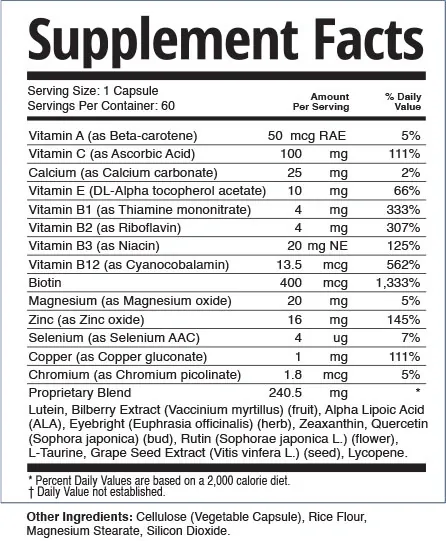
Laid out nutrient by nutrient, TheyaVue's daily amounts sit below AREDS2's tested doses for vitamin C, vitamin E and zinc, match it exactly on copper, and cannot be checked at all for lutein or zeaxanthin because neither has a published amount. None of that makes the bottle dangerous. It does mean that citing AREDS2 anywhere near this label, on this site or anywhere else, describes a resemblance, not a replication.
What to take from AREDS2, and what not to
AREDS2 is one of the better-run, most useful trials in eye health, precisely because its result is specific: a defined formula, in a defined population, slowing a defined disease by a measured amount. Treat any bottle that borrows its name as making a claim about that same narrow thing, and treat any bottle that implies more, sharper sight, prevention in healthy eyes, or a cure, as making a claim the trial never supports.
What this specific label's numbers add up to against that trial is on the ingredients page and the Supplement Facts page. What a biotin-containing formula like this one can do to a blood test, a separate and unrelated safety topic, is covered on the lab tests guide.
AREDS2 Explained: common questions
Who ran the AREDS2 trial?
The National Eye Institute, part of the National Institutes of Health, ran AREDS2 as a large, randomized, double-blind, placebo-controlled trial independent of any single supplement brand.
Who was enrolled in AREDS2?
4,203 people ages 50 to 85 who already had intermediate AMD in both eyes, or advanced AMD in one eye with at least intermediate AMD in the other. Nobody with healthy eyes or only early AMD was enrolled.
What exactly was the AREDS2 daily formula?
Vitamin C 500 mg, vitamin E 400 IU, lutein 10 mg, zeaxanthin 2 mg, zinc 80 mg (or 25 mg in a secondary arm), and copper 2 mg, taken daily.
Did AREDS2 improve anyone's eyesight?
No. It slowed progression to advanced AMD in people who already had the disease. It did not sharpen vision or restore vision already lost.
Does AREDS2 help people who don't have AMD yet?
No benefit was shown for people with no AMD or only early AMD. The trial's population already had intermediate or advanced disease.
Why did AREDS2 replace beta-carotene with lutein and zeaxanthin?
Because high-dose beta-carotene raised lung cancer risk in smokers in two earlier trials. Lutein and zeaxanthin performed at least as well without that risk.
Why did AREDS2 test two different zinc doses?
To see whether 25 mg worked as well as the original 80 mg with less risk to copper absorption, which is why copper was included alongside zinc from the start.
Does a bottle that mentions AREDS2 automatically match it?
No. Check the six nutrients and their exact amounts against the table on this page. Many labels share ingredient names with AREDS2 while using very different doses.
Keep reading
Every ingredient in this bottle
The fourteen measured nutrients and the ten sharing an unmeasured blend, each with its research dose.
Read →The Supplement Facts panel decoded
Per capsule versus per day, side by side, straight from the label.
Read →Supplements and lab tests
How a biotin-containing formula like this one can throw off a blood test, and what to tell the clinic.
Read →Order TheyaVue from the authorized retailer
60 servings per bottle, 1 to 2 droppers a day. Kits of 2, 3 or 6 bottles run from $39 a bottle on the sales page, with a 60-day money-back guarantee. Questions first? Call +1 (315) 724-2018.