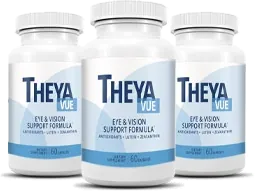
TheyaVue Side Effects and Interactions to Know
TheyaVue side effects mostly come down to three daily amounts: niacin, biotin and zinc.
Niacin reaches 40 mg NE a day, above the 35 mg upper limit, and zinc reaches 32 mg. Biotin at 800 mcg a day can change lab tests, so tell your doctor before blood work.
Any sudden change in your sight means an eye doctor the same day. See who should ask first.
What this page covers, and the one rule that overrides all of it
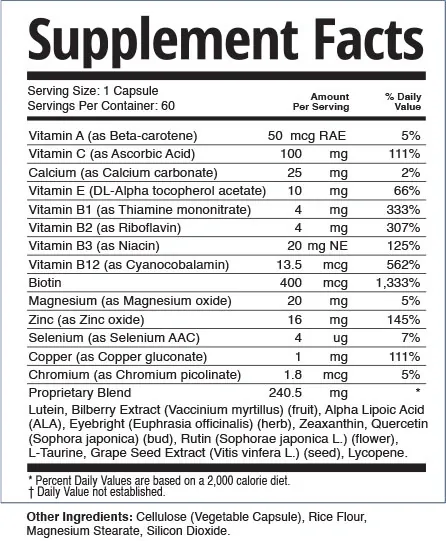
This page collects every safety flag we could verify against a public source for TheyaVue, in one place. Two numbers on the panel cross a published limit. One vitamin needs a word with your doctor before you smoke a cigarette near this bottle. One ingredient can throw off a blood test result. Three more have no published amount at all, which makes them harder, not easier, to judge.
None of that is a reason to panic. It is a reason to read this page before the bottle, not after, and to keep one rule above everything else on it: sudden blurring, flashes, floaters, eye pain or lost vision mean an eye doctor the same day, not a capsule. Nothing below changes that rule. Where each of these amounts comes from on the panel is on the Supplement Facts page, and what each ingredient is actually studied for is on the how it works page.
Five numbers, side by side
| Nutrient | This label, per day | Public limit or concern | Why it matters |
|---|---|---|---|
| Niacin | 40 mg NE / day | 35 mg / day supplemental UL | Form not stated; decides flushing/liver risk |
| Biotin | 800 mcg / day | No UL, but interferes with lab assays | Can falsify troponin and thyroid results |
| Zinc | 32 mg / day | 40 mg / day, all sources UL | Counts toward every other supplement you take |
| Beta-carotene | about 0.2 mg / day | Linked to lung cancer at 20-30 mg/day in smokers | This dose is far below that; caution is precautionary |
| Vitamin E | about 20 mg / day (about 44 IU) | 1,000 mg / day UL; bleeding risk noted above roughly 400 IU | Well under either threshold alone |
Niacin passes a published upper limit
Two capsules a day give 40 mg NE of niacin. NIH's Office of Dietary Supplements sets the Tolerable Upper Intake Level for supplemental niacin at 35 mg a day, based on the flushing reaction niacin can cause National Institutes of Health, 2022. That limit applies to niacin from supplements, not niacin naturally occurring in food, so this 40 mg counts fully against it.
The panel lists the amount as "20 mg NE" per capsule and never says which chemical form it uses. That distinction matters: nicotinic acid causes the flushing reaction directly, while nicotinamide generally does not, and the fact sheet's 35 mg limit does not separate the two forms. Without knowing the form, neither you nor we can say how likely flushing is at this dose. Anyone with liver disease, gout or a peptic ulcer should raise this specific number with a doctor before starting.
Biotin can falsify a blood test result
Eight hundred micrograms of biotin a day is well below the doses linked to the worst lab interference, but the mechanism does not have a clean safety floor. NIH's Office of Dietary Supplements reports that a single 10 mg dose affected thyroid test results within 24 hours, that biotin has caused false diagnoses of Graves' disease at 10-300 mg/day, and describes a reported patient death linked to a falsely low troponin result National Institutes of Health, 2022.
The FDA has issued its own safety communication on this, specifically about troponin, the test used to diagnose a heart attack in the emergency room. It published a list of troponin test devices known to be affected by biotin without a workaround, after receiving reports of falsely low results, and advises lab staff to ask patients about biotin supplement use U.S. et al., 2022. The practical takeaway does not depend on the exact dose: tell any clinic drawing your blood, especially before cardiac or thyroid testing, that you take a biotin-containing supplement.
Zinc counts toward a shared ceiling
Thirty-two milligrams of zinc a day sits under the 40 mg adult Tolerable Upper Intake Level from all sources combined National Institutes of Health, 2026, but that ceiling adds up across everything in your cabinet: a multivitamin, a cold-remedy lozenge, a separate zinc supplement. Room under the limit shrinks fast once you stack products.
Zinc at 50 mg a day or more, mostly from supplements, can interfere with copper absorption and cause a copper deficiency National Institutes of Health, 2026, which is why a real eye formula pairs the two. This label's 2 mg of copper a day is an exact match for AREDS2's copper amount, so that specific safeguard is handled correctly here, even though the rest of the formula does not match the trial.
Beta-carotene and a lung cancer signal in smokers
This label's vitamin A comes from beta-carotene, at a trace 50 mcg RAE a capsule (100 mcg RAE a day), equal to roughly 0.2 mg of beta-carotene. That is nowhere near the doses that raised concern: the CARET trial gave smokers and asbestos-exposed workers 30 mg/day beta-carotene plus retinyl palmitate and found 28% more lung cancer and 46% more lung cancer deaths than placebo, stopping the trial early Omenn et al., 1996; the ATBC trial found 18% more lung cancer in male smokers taking 20 mg/day beta-carotene National Institutes of Health, 2025. Both harms appeared only in smokers and former smokers, not in nonsmokers studied elsewhere, and both are why AREDS2 dropped beta-carotene for lutein and zeaxanthin.
At roughly one-hundredth of those doses, this product carries no established cancer signal on its own. If you smoke or used to, the honest caution is about stacking: mention this product to a doctor before adding any separate high-dose beta-carotene supplement on top of it.
Vitamin E and bleeding risk
NIH's Office of Dietary Supplements sets the adult Tolerable Upper Intake Level for vitamin E at 1,000 mg a day and warns that large supplemental doses, with one physicians' trial using 400 IU (about 180 mg) every other day for eight years, have been linked to a higher hemorrhagic stroke risk, and can raise bleeding risk further when combined with a blood thinner such as warfarin National Institutes of Health, 2021. This label supplies about 20 mg a day (roughly 44 IU) of the synthetic DL-alpha form, under a ninth of the amount used in that trial and far under the 1,000 mg UL.
The dose here is not the concern. The concern is what else might be in the blend: quercetin and grape seed extract both carry their own theoretical bleeding notes, and their amounts are not published, so anyone already on a blood thinner should mention this whole product to a doctor rather than reasoning from the vitamin E line alone.
Quercetin and grape seed extract
A dedicated safety review of quercetin found mostly mild effects in short-term human studies, but flagged a lack of long-term (over 12 weeks) data at high supplemental doses of 1,000 mg or more, a theoretical concern for worsening kidney injury in people with existing kidney disease, a theoretical concern around estrogen-dependent cancers from animal data, and documented interactions that can alter the blood levels of certain medications Andres et al., 2018. This blend's entire ten-ingredient total is 481 mg a day, so quercetin alone cannot plausibly reach 1,000 mg here, but its exact share is unpublished.
Grape seed extract's one real randomized trial, 150 mg/day for a year in people with diabetic retinopathy, reported only mild gastrointestinal side effects and no serious safety signal Moon et al., 2019. That trial dose alone is close to a third of this entire blend, which is a reminder of how little room 481 mg leaves for ten ingredients at meaningful amounts.
Why an unpublished blend makes every interaction harder to judge
Every caution above about the itemised nutrients is at least checkable, because every itemised amount is printed. The Proprietary Blend is not. Lutein, bilberry extract, alpha lipoic acid, eyebright, zeaxanthin, quercetin, rutin, L-taurine, grape seed extract and lycopene share one 240.5 mg line with no individual amount. That makes an honest interaction check impossible in the way an itemised list allows.
Alpha lipoic acid can affect blood glucose control, which matters for anyone on insulin or another glucose-lowering medicine, and its research dose, 600 mg a day, is already larger than this whole blend Haritoglou et al., 2011. Bilberry's anthocyanins are sometimes flagged for a theoretical additive effect with blood-thinning or blood-sugar medication, a concern not independently confirmed in the review we checked Canter et al., 2004. Whether either ingredient sits at a dose worth worrying about, or barely registers, cannot be answered from this label. That uncertainty, multiplied across ten ingredients, is itself the safety issue.
Symptoms that mean an eye doctor today, not a capsule
- Sudden blurring, in one eye or both.
- Flashes of light, or new floaters, especially many at once.
- Eye pain, redness that will not clear, or a sudden change in how a light looks (halos, glare).
- Any sudden loss of vision, partial or complete.
Any one of these means calling an eye doctor the same day, not waiting to see if a supplement helps. These are signs of conditions, from a retinal detachment to a vascular event, that a capsule cannot treat and that lose ground the longer they go unexamined. Nothing on this page, or anywhere on this site, is a substitute for that appointment.
Side Effects: common questions
Is TheyaVue's niacin amount dangerous?
It passes the 35 mg/day upper limit set for supplemental niacin at 40 mg NE/day, which is worth a doctor's input, especially since the label does not state the chemical form. It is not automatically dangerous for everyone.
Why does biotin matter if I feel fine?
Biotin can distort certain blood test results, including troponin and thyroid panels, even without causing any symptoms. Tell your doctor or lab you take it before bloodwork.
Can I take TheyaVue with a separate zinc supplement?
Be careful. This label already supplies 32 mg of zinc a day, and the adult upper limit from all sources is 40 mg. Stacking supplements can push past that quickly.
I smoke. Is the beta-carotene here a problem?
At about 0.2 mg a day it is far below the doses linked to lung cancer risk in smokers in large trials, but mention any eye supplement to your doctor if you smoke or used to.
Does the unpublished blend make interactions more dangerous?
It makes them harder to assess, which is not the same as more dangerous. Several blend ingredients have their own interaction notes, and without amounts, no one can size the real risk.
What symptoms should send me to an eye doctor immediately?
Sudden blurring, flashes, new floaters, eye pain or any sudden vision loss. See an eye doctor the same day; do not wait to see if a supplement helps.
Should I stop TheyaVue before surgery?
Ask your surgeon. Vitamin E, quercetin and grape seed extract all carry bleeding-related notes in the literature, and their exact amounts here are not published.
Keep reading
Every ingredient, inside and out
The fourteen itemised nutrients and the ten sharing the 240.5 mg blend, with the research behind each one.
Read →Reading the Supplement Facts panel
Serving size versus directions, the dagger symbol, %DV and the mineral forms behind these numbers.
Read →The AREDS2 trial, explained fully
Who it was tested in, what it found, and how this label's zinc, copper, vitamin C and vitamin E compare.
Read →Order TheyaVue from the authorized retailer
60 servings per bottle, 1 to 2 droppers a day. Kits of 2, 3 or 6 bottles run from $39 a bottle on the sales page, with a 60-day money-back guarantee. Questions first? Call +1 (315) 724-2018.