Supplements and lab tests: what to tell the clinic
Biotin can interfere with immunoassay-based lab tests, including troponin and thyroid panels, an interference the FDA has warned about. Documented problems generally start around 10 mg a day and up, well above typical multivitamin doses. Telling the clinic you take it, rather than stopping blindly, is the recommended fix. Vitamin E, vitamin C and zinc are also worth mentioning before blood work or surgery.
Why a vitamin bottle matters to a blood test
A nurse draws your blood, a machine reports a number, and a doctor makes a decision from that number, often within minutes. Almost nobody in that chain thinks to ask what vitamins you took this morning. For most supplements, that gap never matters. For a short list of them, it can change the number enough to change the decision, and biotin, a common ingredient in eye, hair, skin and nail formulas, sits near the top of that short list.
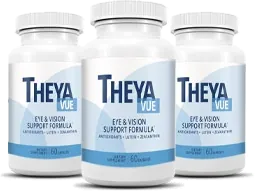
TheyaVue contains 800 mcg of biotin a day at the label dose, which is well below the amounts most tied to serious interference, but "well below the worst cases" is not the same as "irrelevant," and this guide explains exactly why, plus a wider list of what else is worth mentioning before a blood draw or a surgery date.
How biotin actually interferes with a lab test
Many common lab tests, including the ones used to check for a heart attack or a thyroid problem, use a lab method called an immunoassay. A large share of these assays use a biotin-streptavidin chemical step as part of how they detect the substance being measured. Take in enough extra biotin, and it can compete in that same chemical step, throwing the number off in one direction or the other depending on how the specific test is built.
| Test type | What it is used for | How biotin can distort it |
|---|---|---|
| Troponin | Diagnosing a heart attack in the emergency room | Can produce a falsely low result, potentially masking a real heart attack |
| Thyroid panels (TSH, T3, T4) | Diagnosing thyroid problems, including Graves' disease | Can produce falsely abnormal results, including false Graves' disease diagnoses |
| Certain hormone panels | Fertility, reproductive and other hormone testing | Immunoassay-based hormone tests can be affected by the same biotin-streptavidin mechanism |
What the FDA actually said
The FDA has published a safety communication specifically about biotin interfering with troponin testing, after receiving reports of falsely low troponin results in patients taking biotin supplements. The agency went as far as publishing a list of troponin test devices known to be susceptible to this interference without a built-in fix, and it advises health care providers and lab staff to ask patients directly about biotin supplement use U.S. et al., 2022.
NIH's Office of Dietary Supplements separately documents how fast and how badly this can go: a single 10 mg dose affecting thyroid results within 24 hours, false diagnoses of Graves' disease reported at doses of 10 to 300 mg a day, and a reported patient death linked to a falsely low troponin result National Institutes of Health, 2022. Those are the extreme end of the range, not the typical case, but they are the reason this specific supplement-lab interaction gets its own guide rather than a single line on a side-effects page.
Why the dose matters, and where this product sits
Biotin dosing on the market spans an enormous range, and where a given product falls on that range matters for how seriously to take this.
| Source | Typical biotin amount | Interference risk |
|---|---|---|
| A standard daily multivitamin | About 30 mcg (the adult Adequate Intake) | Essentially none reported at this level |
| TheyaVue at the label dose | 800 mcg a day (400 mcg per capsule, twice daily) | Above the Adequate Intake; documented interference has generally been reported starting closer to the milligram range and up |
| A dedicated hair/skin/nail biotin product | Commonly 5,000 to 10,000 mcg (5 to 10 mg) or more | The dose range where clinically significant interference has actually been documented and reported |
NIH ODS notes documented lab-test interference generally starting around 10 mg (10,000 mcg) a day and up, with case reports across a 5 to 300 mg range, and states that no Tolerable Upper Intake Level exists for biotin because no toxicity has been demonstrated even at doses up to 200 mg a day National Institutes of Health, 2022. TheyaVue's 800 mcg a day sits far below that documented interference range. The mechanism is still real at any dose above zero; the dose just changes how likely a clinically meaningful distortion actually is.
Why telling the clinic beats stopping cold
The instinct many people have on reading this is to stop every supplement a few days before any blood draw, just in case. That is not what the FDA or NIH actually recommend, and it is not necessary for most people at typical supplement doses. The recommended fix is simpler and more reliable: tell the clinic drawing your blood, or the surgical team scheduling a procedure, that you take a biotin-containing supplement and roughly how much.
A lab that knows can choose a test method less prone to biotin interference, time the draw around your last dose, or simply flag the result for a second look if something seems off. A patient who quietly stops a supplement without mentioning it removes one variable but leaves the clinic guessing about everything else, including whether stopping itself changed anything relevant to why the test was ordered in the first place.
Beyond biotin: what else is worth mentioning
Biotin is the clearest example, but it is not the only supplement worth a mention before bloodwork or a procedure. A few others come up often enough to belong on the same list.
Vitamin E and bleeding
NIH ODS warns that large supplemental vitamin E doses, particularly well above roughly 400 IU a day, have been linked to increased hemorrhagic stroke risk and can raise bleeding risk when combined with a blood thinner such as warfarin National Institutes of Health, 2021. Worth mentioning before any surgery, even though TheyaVue's roughly 20 mg (about 44 IU) a day is far below the doses that raise this concern on its own.
High-dose vitamin C
NIH ODS sets the adult Tolerable Upper Intake Level for vitamin C at 2,000 mg a day, with diarrhea, nausea and abdominal cramps as the most common effects above it, plus a kidney-stone risk in susceptible people and a risk of worsening iron overload in hereditary hemochromatosis at high intakes National Institutes of Health, 2025. Anyone taking a separate high-dose vitamin C supplement on top of a multivitamin should mention the combined total to a clinic, especially before any test that already carries a kidney or iron-related concern.
Zinc and copper status
NIH ODS reports that zinc intakes of 50 mg a day or more, mostly from supplements, can interfere with copper absorption and cause a copper deficiency, and that zinc oxide absorbs at only about 50% compared with roughly 61% for zinc citrate or gluconate National Institutes of Health, 2026. Worth mentioning if a clinic is investigating unexplained fatigue, anemia or nerve symptoms, since low copper status can produce its own confusing lab picture.
What to tell the clinic, step by step
List every supplement, not just the prescription bottle
A clinic asking 'what medications are you on' does not always prompt people to mention a daily multivitamin, an eye formula or a biotin gummy. Say it anyway.Include the dose, not just the name
Biotin at 30 mcg and biotin at 10,000 mcg are different conversations. Bring the label or a photo of it if you are not sure of the number.Say when you last took it
Same-day timing matters more for some interference mechanisms than others; a clinic can judge that faster than you can.Ask before stopping anything on your own
Some supplements are fine to stop for a day or two before a test; others, taken for a real medical reason, should not be stopped without asking first.Mention it again before surgery specifically
A pre-operative team asks similar questions but at a different moment, and bleeding-related supplements like vitamin E deserve a second mention there.
Where this shows up on this specific bottle
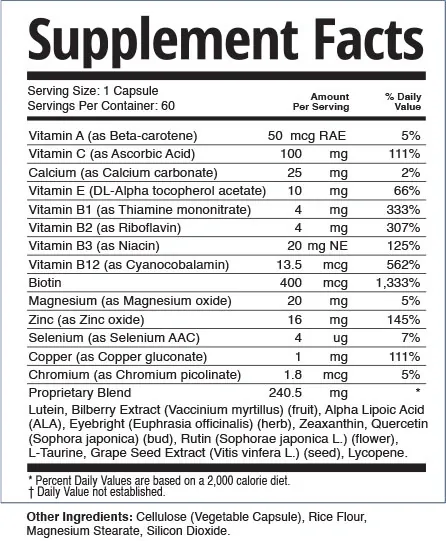
The line that started this guide sits in plain sight on the back of this bottle. Biotin, 400 mcg per capsule, 800 mcg a day at two capsules, printed at 1,333% of the Daily Value per capsule the way most B-vitamins are, because biotin is cheap, water-soluble and rarely a safety concern at ordinary multivitamin doses on its own.
What the panel cannot do is warn you about a lab test you have not scheduled yet. That warning has to come from you, to the person drawing your blood, and that is the one piece of information a Supplement Facts label was never designed to carry.
The short version to actually act on
None of this is a reason to avoid biotin, vitamin E, vitamin C or zinc, all of which have ordinary, well-tolerated roles at typical supplement doses. It is a reason to say what you are taking out loud, once before a blood draw and once before a procedure, rather than assuming a label a lab tech has never seen will somehow announce itself.
Every other safety flag we could verify for this specific product, including the niacin and zinc limits, is on the side effects page. What the AREDS2 trial actually tested, a separate topic from lab-test interference entirely, is on the AREDS2 guide.
Supplements and Lab Tests: common questions
Can biotin really change a blood test result?
Yes. Many common immunoassay-based tests, including troponin and thyroid panels, use a biotin-streptavidin step that extra biotin can interfere with, skewing the reported number.
What did the FDA actually warn about?
The FDA published a safety communication on biotin interfering with troponin testing specifically, listing affected test devices and reporting cases of falsely low results.
Should I stop taking my supplement before a blood test?
Not automatically. Tell the clinic you take it and roughly how much, so they can choose an appropriate test or account for it, rather than stopping without asking.
Is 800 mcg of biotin a day dangerous for lab tests?
It is well below the doses most clearly tied to serious interference, which generally start closer to 10 mg and up, but the mechanism can apply at any dose, so it is still worth mentioning.
What other supplements should I mention before surgery?
Vitamin E at high doses has bleeding-related literature, and any separate high-dose vitamin C or zinc supplement is also worth mentioning to a surgical team.
Is high-dose vitamin C worth mentioning before blood work?
Yes. NIH ODS sets a 2,000 mg daily upper limit, above which it can raise kidney-stone risk or worsen iron overload in hereditary hemochromatosis, both worth flagging to a clinic.
Why does zinc dosing matter for lab results?
High zinc intake can cause a copper deficiency, which can produce its own confusing lab picture, such as unexplained anemia or nerve symptoms.
Where can I read every safety flag for this specific product?
The side effects page covers the niacin and zinc limits, beta-carotene and vitamin E notes specific to this label, each with its source.
Keep reading
Every verified side effect on this label
Niacin's upper limit and zinc's ceiling, alongside the biotin warning, each with its source.
Read →AREDS2 explained in full
The eye trial this product is measured against, and what it actually tested and found.
Read →The Supplement Facts panel decoded
Where the biotin, niacin and zinc lines sit on the actual label, per capsule and per day.
Read →Order TheyaVue from the authorized retailer
60 servings per bottle, 1 to 2 droppers a day. Kits of 2, 3 or 6 bottles run from $39 a bottle on the sales page, with a 60-day money-back guarantee. Questions first? Call +1 (315) 724-2018.