Eye Supplement Marketing: Eight Claims Worth Stopping On
Eye-supplement marketing repeats a short list of red flags: 20/20 promises, 'reverses' or 'restores' language, trick or exercise framing, invented doctors, before-and-after eye charts, countdown timers, dramatic testimonials, and front-label ingredients with no amounts. The honest version of each uses support language, names real credentials, and discloses real numbers. This product's own sales funnel carries a headline like this, and this site does not repeat it.
Why eye supplements draw a particular kind of marketing
Eye supplements get marketed differently than most other categories, and there is a simple reason for it: losing part of your ability to see is frightening in a way that, say, low energy or joint stiffness usually is not. Fear sells urgency, and urgency sells the kind of claim a careful label never would.
This is a reader’s guide to the specific patterns that show up over and over in eye-supplement marketing. None of the eight patterns below are unique to any one product, and spotting them does not require any background in medicine or biochemistry. It requires recognizing a small, repeatable list of moves and knowing what an honest version of the same information would look like instead.
Each one is paired here with the honest version, so the point is not just what to avoid, but what a trustworthy version of the same claim actually reads like.
Promises of 20/20 vision or throwing away your glasses
A headline promising a specific visual outcome, such as a named acuity result or a scenario where someone throws away their glasses, is describing a medical outcome no dietary supplement is permitted, or able, to deliver. Visual acuity is measured by an eye care professional with specific instruments and a standardized chart. It is not restored by a capsule.
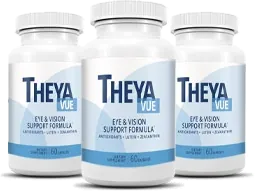
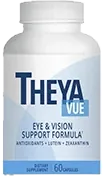
A legitimate eye supplement makes a structure or function statement: language about supporting eye health, or supporting antioxidant activity in the eye, without naming a specific visual result. TheyaVue’s own front label reads “Eye & Vision Support Formula,” a support claim, not an acuity promise, and every supplement sold in the United States is required to carry a line stating it has not been evaluated by the FDA and is not intended to diagnose, treat, cure or prevent any disease.
If a specific numeric vision outcome, or an image of glasses being discarded, appears anywhere in the marketing for a product, that claim did not come from the label sitting in the box. It came from a sales page built to sell past the label, not to describe what is in it.
"Reverses" and "restores" language
"Reverses" and "restores" describe undoing damage that has already happened. That is a treatment claim, and it sits in a different regulatory category than anything a dietary supplement is allowed to say. The honest research in this space, discussed at length in the AREDS2 trial, only ever claims to slow how quickly an existing condition gets worse, never to undo it.
The National Eye Institute is explicit that its own studied formula does not restore vision already lost, and helps only in people who already have intermediate or advanced macular degeneration (National Eye Institute (NEI), 2025). If the best-funded, most rigorously tested eye formula on record makes no reversal claim, a bottle that does is making a claim its own reference research does not support.
Honest language uses words like "support," "help maintain," or "may help slow," each of which leaves the existing condition, and the direction it is heading, alone. None of those phrases promise to turn back a change that has already occurred.
A trick, an exercise, or a movement framing
A named trick, a specific hand or finger movement, a short exercise, or anything else framed as a quick physical technique that supposedly delivers a vision result in seconds, is designed to feel like a discovery rather than a sales pitch. Genuine biology does not work on that timescale. The pigment changes and antioxidant activity discussed in real eye research are measured in months, not seconds, precisely because that is how long the relevant tissue actually takes to change.
An honest source separates a supplement, which works gradually through diet-like biological pathways, from any claim of a quick technique. If a page mixes a capsule sale with a countdown-timed exercise or movement, that combination itself is the tell, because a real nutrient does not need a trick to accompany it.
Nothing about a hand movement changes how much lutein reaches a retina, or how quickly. A framing built around a trick is built to distract from that fact, not to explain it.
Invented doctors and unnamed experts
A marketing mark like "Doctor Developed," an unnamed "leading expert," or a described-but-unnamed clinical team, cannot be verified by a reader, and that is usually the point. A real clinician behind a formula is someone with a name, a credential, and a license that can be looked up.
An honest page names the clinician, states their credential, and lets a reader confirm both. TheyaVue’s own packaging carries a "Doctor Developed" mark with no clinician named anywhere in the material behind it, which this site treats as an unverified marketing mark rather than a credentialed endorsement, because that is exactly what it is.
The same logic applies to any claim that a specific percentage of doctors or eye specialists recommend a product. The Federal Trade Commission has taken enforcement action against an eye-supplement marketer for exactly that kind of fabricated statistic, alongside claims the product could restore lost vision and eliminate floaters (Federal et al., 2005). A verifiable name and a real number are different things from an invented one.
Before-and-after eye charts and countdown timers

A real Snellen eye chart measures sight under standardized, controlled conditions. A supplement advertisement is not a controlled condition, and a single curated before-and-after image proves nothing: it is not a study, has no control group, and cannot rule out a hundred other explanations for a change, including simply choosing which image to publish.
A countdown timer next to a price, claiming a sale ends in minutes, plays on the same urgency as the eye chart image. It has nothing to do with biology and everything to do with getting a purchase decision made before a reader has time to check anything.
Genuine evidence comes from a peer-reviewed trial with a control group, a defined dose, and a result reported across many participants rather than one photograph. A price that is the same tomorrow as it is today, with no artificial countdown, is a page that does not need urgency to make its case.
Testimonials with dramatic vision claims
A testimonial describing a dramatic vision improvement, especially one paired with a photo or a specific acuity number, is doing the same work as a before-and-after chart: presenting one person’s unverified account as though it were evidence. It is not a substitute for a controlled trial, and for an eye product specifically, a fabricated or exaggerated vision-improvement quote is a particularly damaging thing to publish, since it can encourage someone to delay a real eye exam.
An honest source either shows verified, disclosed reviews with their limitations stated plainly, or shows none at all rather than risk publishing something unverified. This site takes the second path: no star ratings, no review counts and no customer quotes appear anywhere here, because the testimonial material supplied for this product was marked as layout copy, not verified feedback, and inventing a customer who claims their sight improved is not a risk worth taking. More on that choice is on the reviews page.
Front-label ingredients with no amounts
An ingredient named on the front of a bottle with no milligram amount anywhere on the panel behind it is a claim you cannot check. TheyaVue names lutein and zeaxanthin on its front label, and both sit inside a single 240.5 mg blend of ten ingredients with no individual amount published for any of them. That is not a reason to assume the worst, but it is a reason the front-label claim cannot be compared to any research dose, including the 10 mg lutein and 2 mg zeaxanthin used in the AREDS2 trial.
A fully disclosed panel lists a milligram amount next to every ingredient, including anything inside a blend. Where a maker chooses not to disclose an amount, an honest page says so plainly next to the ingredient rather than leaving the reader to assume a number that was never printed.
The full walkthrough of what "contains lutein" does and does not tell you is on this site’s lutein explainer, and the panel’s own per-capsule arithmetic is on reading a label per capsule versus per day.
Where this site stands on all of it
Said plainly: the sales funnel this product is sold through carries a headline claiming a fast physical movement restores blurred eyesight to a specific, perfect result. That headline checks nearly every box on this list at once, a restoration claim, a trick framing and a specific acuity promise, all in a few words. This site does not repeat that headline, does not soften it, and does not treat it as anything other than unsupported.
| Where a claim can come from | What it can promise |
|---|---|
| The Supplement Facts panel and the front label | A structure or function statement, like eye and vision support, plus whatever ingredient amounts are actually printed |
| The required FDA disclaimer on every supplement | Nothing. It exists specifically to state the statements above have not been evaluated and are not a disease treatment |
| A sales funnel headline built to sell past the label | Anything at all, including claims the label and the research behind it do not support |
The bottle and the sales page around it are not always written by the same standard, and treating them as one thing is exactly how an unsupported headline ends up believed. Everything else on this site is written against the bottle, the printed panel and the linked research, not against the funnel. Anyone whose vision has changed recently should treat that as a reason to book an eye exam, not a reason to read another marketing page. More on who a support supplement like this reasonably suits, and who should ask a clinician first, is on the who it’s for page and the side effects page.
Questions readers ask
Why do eye supplements get marketed more aggressively than other supplements?
Losing part of your vision is frightening in a way many other health concerns are not, and fear-driven urgency tends to sell claims a careful label never would.
What is wrong with a promise of 20/20 vision?
Visual acuity is a specific medical measurement taken by an eye care professional. No dietary supplement is permitted, or shown, to produce a specific acuity outcome, so a headline promising one did not come from the product label.
Is 'restores eyesight' different from 'supports eye health'?
Yes. 'Restores' claims to undo damage already done, a treatment claim. 'Supports' is a structure or function statement, the category dietary supplement labels are actually allowed to use.
Why is a trick or exercise framing a red flag?
Real changes in eye-related biology, such as macular pigment, take months to measure. A claim of a fast physical trick delivering a vision result in seconds does not match how the underlying biology actually works.
What should I look for instead of a 'Doctor Developed' mark?
A named clinician with a stated, checkable credential. An unnamed doctor or an unverified percentage of recommending physicians cannot be confirmed by a reader, which is usually the point.
Why does this site have no reviews or testimonials?
The testimonial material supplied for this product was marked as layout copy, not verified feedback. Publishing invented customer quotes for an eye product risks encouraging someone to delay a real eye exam, so this site publishes none.
Why does a missing ingredient amount matter?
Without a printed milligram amount, a front-label ingredient claim cannot be compared to any research dose, including the amounts used in major eye trials, so the claim is unverifiable either way.
Does this site quote the sales funnel's headline directly?
No. This site describes that the funnel carries a vision-restoration headline of this kind and explains why it is unsupported, without repeating the headline itself as a standalone line.
Keep reading
Per capsule versus per day
What Serving Size legally means, why a per-capsule panel halves every percentage on a twice-daily product, and how it ch...
Read →What lutein actually does
What lutein and zeaxanthin are, macular pigment, food sources, the AREDS2 dose, and why naming lutein with no amount tel...
Read →How much does TheyaVue cost?
Pack sizes, days of supply and how to pick the right one.
Read →Order TheyaVue from the authorized retailer
60 servings per bottle, 1 to 2 droppers a day. Kits of 2, 3 or 6 bottles run from $39 a bottle on the sales page, with a 60-day money-back guarantee. Questions first? Call +1 (315) 724-2018.