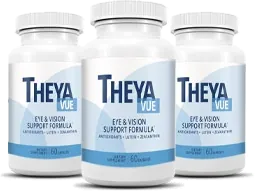
TheyaVue Results Timeline: What to Expect and When
TheyaVue results build slowly, over weeks and months.
Week 1 is about making the routine stick. Macular pigment studies usually report change from weeks 8 to 12 and over three to six months, and your next eye exam is the real measure.
To stay consistent, follow how to use TheyaVue.
Why a supplement timeline is different from a delivery tracker
A capsule does not report back the way a package tracker does. There is no notification that says the second week is going well. The only honest way to talk about a timeline here is to say what the biology can plausibly do on what schedule, and to say it plainly when the schedule outruns anything a bottle can show in the meantime.
The carotenoids this product advertises on its front label, lutein and zeaxanthin, build up in eye tissue slowly. Wilson et al., 2021 pooled 46 studies and found the change researchers can actually measure, macular pigment optical density, took three to six months to show up in a lab, and even then the amount of change depended heavily on the dose, which this label does not publish for either carotenoid.
Week 1: the habit, not the effect
In week one, the honest answer is nothing. No supplement, including this one, changes how a retina works in seven days. What week one actually establishes is whether the routine sticks: two capsules a day, 20-30 minutes before a meal, with 8 oz of water each time.
Anyone waiting for a sign in the first week is watching the wrong thing. The bottle does not claim a first-week effect, and the only trials behind any of its ingredients ran for months, not days.
A realistic first three months
Four points on a calendar, and an honest note about what each one can and cannot tell you.
- Week 1
Building the habit, nothing to measure yet
Two capsules a day, before meals, with water. Nothing about eye tissue changes on this timescale, and no research claims it does.
- Weeks 4-8
Still too early for the carotenoid question
This is roughly the front edge of where lutein and zeaxanthin research starts to report change, and even then only in trials that published a dose. This label does not.
- Weeks 8-12
Where the macular pigment research actually reports
The meta-analysis behind this claim pooled studies running three to six months. A self-reported sense of sharper vision at this point is not the same as a measured change.
- Your next eye exam
The only real measurement
An optometrist or ophthalmologist has instruments that check what a mirror and a feeling cannot. That appointment, not the calendar, is what actually tells you anything.
Why macular pigment studies take months, not weeks
| Question | What the research shows |
|---|---|
| How fast does macular pigment change register in a study? | Wilson et al., 2021 found a measurable change in macular pigment optical density across studies that mostly ran three to six months, not days or weeks. |
| Does more lutein and zeaxanthin mean more change? | The same meta-analysis found intakes of 20 mg a day or more produced a larger measured change than intakes between 5 and 20 mg a day, with no significant change below 5 mg a day. This label's amount for either carotenoid is not published. |
| Does a measured pigment change mean sharper vision? | No trial in this body of research equates a pigment density change with restored or sharpened eyesight. It is a tissue measurement, not a vision test. |
| What did AREDS2 measure, and over what time? | Age-Related et al., 2013 followed participants for about five years and measured progression to advanced macular degeneration in people who already had the disease, not an improvement in sight for anyone. |
None of this is a criticism of the ingredients specifically. It is a plain statement that the science behind carotenoid supplementation was never built to produce a two-week or even two-month verdict, and a label that hides its own carotenoid dose makes that verdict even less checkable.
The 60-day guarantee against a months-long research clock
TheyaVue's guarantee runs 60 days from the purchase date. Two bottles at the label dose cover exactly that window. The macular pigment research this category leans on mostly needed three to six months, which is 90 to 180 days, to show a measured change. The refund window closes well before that point, on every kit size.
| Kit | Days of supply | Guarantee closes at day | Days of supply still inside the guarantee |
|---|---|---|---|
| 1 bottle | 30 | 60 | 30 of 30 (all of it) |
| 3 bottles | 90 | 60 | 60 of 90 (about two thirds) |
| 6 bottles | 180 | 60 | 60 of 180 (one third) |
A single bottle happens to fit inside the guarantee window entirely, simply because 30 days of supply is shorter than 60 days of guarantee. The three and six-bottle kits do not: their later bottles are already past the return window by the time the pigment research this category is built on would even start reporting a change. That is a purchase-timing fact, not a claim about whether the ingredients work.
Not every ingredient here has a timeline at all
The blend also carries a second ingredient with a timeline problem: bilberry. Canter et al., 2004 reviewed the placebo-controlled trials behind the old wartime story that bilberry sharpens night vision and found no rigorous evidence that it improves normal night vision at all, on any timeline, let alone a fast one. There is no window, short or long, in which that particular claim is expected to show up, because the controlled research never found the effect in the first place.
That matters for a timeline page specifically: some of what is inside this blend was never going to report back no matter how long you waited, while lutein and zeaxanthin at least have a plausible, published research window, just not one this label's undisclosed dose lets you check against.
What to track instead of waiting for a feeling
What to actually track
- Whether you took two capsules a day, before meals, with water. That is the only variable you fully control.
- Whether anything about your vision changed suddenly. If it did, that is an appointment, not a data point for this timeline.
- Your next scheduled eye exam date. Instruments measure what a feeling cannot, and that appointment was going to happen with or without this bottle.
What not to expect from the calendar alone
- A noticeable change in sharpness at any specific week. Nothing in the label or the research behind its parts promises one.
- Confirmation of a lutein or zeaxanthin dose working as advertised. The amount is not published, so there is nothing on the label to confirm against.
Keeping the habit and the biology separate
The fairest way to read a timeline for a product like this is to separate the habit from the biology. The habit, two capsules a day before meals, is yours to keep or drop on any schedule you like. The biology, if the undisclosed carotenoid amounts happen to be meaningful, runs on a clock measured in months, and even then in tissue density, not sharpness. Your eye doctor is the only party in this whole picture with an instrument that measures the thing you actually care about. Details on the label itself are on the Supplement Facts page, and on who this product is meant for in the first place, see the who-it's-for page. For anything about an order or a return, call +1 (315) 724-2018.
Results Timeline: common questions
When will I notice a difference from TheyaVue?
There is no established week or month when a difference should appear. The research behind its carotenoids measured tissue-level change over three to six months, not a felt improvement in sharpness.
Why do macular pigment studies take so long?
Lutein and zeaxanthin build up in eye tissue gradually. A meta-analysis of 46 studies found measurable change in macular pigment density mostly after three to six months of intake, and the amount of change depended on the dose taken.
Does TheyaVue publish how much lutein and zeaxanthin it uses?
No. Both sit inside an undisclosed 481 mg daily blend of ten ingredients, so there is no published dose to compare against the research timeline.
Will an eye exam show if TheyaVue is working?
An eye exam measures your eyes with instruments, which is more reliable than a personal impression. It cannot attribute a change specifically to a supplement, since many things affect eye health over months.
Does the 60-day guarantee cover the whole research timeline?
No. Sixty days is roughly the low end of when carotenoid research starts reporting change, and it closes well before the three-to-six-month window most studies actually used.
Should I buy the 6-bottle kit to be safe?
That is a supply and budget decision. Be aware that only the first third of a 6-bottle kit's 180-day supply falls inside the 60-day guarantee window.
What should I actually track while taking it?
Whether you kept the two-capsules-a-day routine, and whether anything about your vision changed suddenly, which calls for an eye doctor regardless of the calendar.
Can this product restore vision that has already changed?
No. No supplement restores eyesight already lost. A recent or ongoing change in vision calls for an eye exam, not a supplement trial.
Keep reading
How to use TheyaVue
The exact routine this timeline assumes: two capsules a day, before meals, with water.
Read →Who TheyaVue is for
Who this product suits and who should talk to a clinician before starting.
Read →AREDS2 explained
The eye trial every product like this is measured against, and what it actually found.
Read →Order TheyaVue from the authorized retailer
60 servings per bottle, 1 to 2 droppers a day. Kits of 2, 3 or 6 bottles run from $39 a bottle on the sales page, with a 60-day money-back guarantee. Questions first? Call +1 (315) 724-2018.