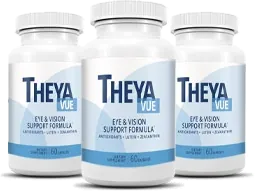
TheyaVue Ingredients: What Each Capsule Contains
TheyaVue contains 14 vitamins and minerals plus a 240.5 mg blend of ten more ingredients.
The blend holds the lutein and zeaxanthin named on the front of the bottle. Each amount on the label doubles at the daily dose of two capsules.
To read every line, see the TheyaVue supplement facts.
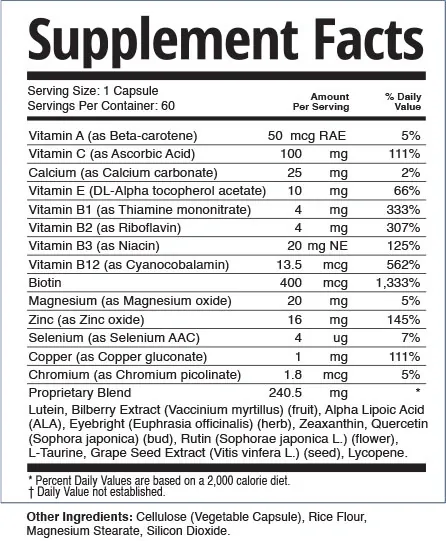
Fourteen measured nutrients, and ten that share one number
Two different ingredient lists sit on the same panel, and they deserve two different kinds of trust.
The TheyaVue panel lists fourteen vitamins and minerals with a measured amount each, then one 240.5 mg line called the Proprietary Blend, holding ten more ingredients that share a single total. Fourteen numbers you can check against a public limit. Ten you cannot. Every figure is per capsule, and the label asks for two a day, so the real daily amount doubles. Line-by-line label reading is on the Supplement Facts page.
The fourteen itemised nutrients, line by line
Copied straight from the bottle. Nothing here is estimated.
| Nutrient | Per capsule | %DV per capsule | Per day, two capsules |
|---|---|---|---|
| Vitamin A (as Beta-carotene) | 50 mcg RAE | 5% | 100 mcg RAE |
| Vitamin C (as Ascorbic Acid) | 100 mg | 111% | 200 mg |
| Calcium (as Calcium carbonate) | 25 mg | 2% | 50 mg |
| Vitamin E (as DL-Alpha tocopherol acetate) | 10 mg | 66% | 20 mg |
| Vitamin B1 (as Thiamine mononitrate) | 4 mg | 333% | 8 mg |
| Vitamin B2 (as Riboflavin) | 4 mg | 307% | 8 mg |
| Vitamin B3 (as Niacin) | 20 mg NE | 125% | 40 mg NE |
| Vitamin B12 (as Cyanocobalamin) | 13.5 mcg | 562% | 27 mcg |
| Biotin | 400 mcg | 1,333% | 800 mcg |
| Magnesium (as Magnesium oxide) | 20 mg | 5% | 40 mg |
| Zinc (as Zinc oxide) | 16 mg | 145% | 32 mg |
| Selenium (as Selenium AAC) | 4 mcg | 7% | 8 mcg |
| Copper (as Copper gluconate) | 1 mg | 111% | 2 mg |
| Chromium (as Chromium picolinate) | 1.8 mcg | 5% | 3.6 mcg |
| Proprietary Blend | 240.5 mg | † | 481 mg |
The dagger by the Proprietary Blend means no Daily Value has been set for it, so no percentage can legally print there.
Everything sharing the 240.5 mg Proprietary Blend
Ten ingredients, one printed weight, doubling to 481 mg a day.
- 1Luteinnot published
- 2Bilberry ExtractVaccinium myrtillus, fruitnot published
- 3Alpha Lipoic Acid (ALA)not published
- 4EyebrightEuphrasia officinalis, herbnot published
- 5Zeaxanthinnot published
- 6QuercetinSophora japonica, budnot published
- 7RutinSophora japonica L., flowernot published
- 8L-Taurinenot published
- 9Grape Seed ExtractVitis vinifera L., seednot published
- 10Lycopenenot published
US rules let a maker print one total instead of ten amounts, and this maker has used that. The order is the only clue you get: labels run a blend from heaviest to lightest, so lutein leads it and lycopene closes it. Split evenly, 481 mg across ten would be about 48 mg each, but nobody outside the factory knows how it is actually divided.
Lutein and zeaxanthin, named on the front, sit inside this total with eight others and no number of their own. The order runs heaviest to lightest: a rank, not a gram figure.
What research exists for each ingredient here
Open any tab for its research dose, its safety note and its sources. A fuller walkthrough of what each group is studied for sits on the how it works page.
Lutein and Zeaxanthin
xanthophyll carotenoids · marigold and pepper sourced
The two the bottle front advertises, and the two whose amounts the panel does not give. Lutein and zeaxanthin are two of the ten ingredients inside this product's undisclosed 481 mg/day proprietary blend, so the actual daily amount of each cannot be verified against the 12 mg/day AREDS2 used or the 20 mg/day associated with the larger effect in the meta-analysis.
- In one serving
- Inside the 240.5 mg blend (amounts not published)
- Dose used in research
- AREDS2 used 10 mg lutein + 2 mg zeaxanthin/day
- Safety note
- Lutein and zeaxanthin have a good general safety record in the doses studied (up to and beyond 20 mg/day combined), with high-dose carotenoid intake occasionally causing harmless yellowing of the skin (carotenodermia).
- Sources
- Wilson et al., 2021
Bilberry Extract
Vaccinium myrtillus · fruit
Second in the blend by weight. Famous for a wartime night-vision story that trials never confirmed. A systematic review found no rigorous evidence that bilberry improves night vision in people with normal eyes, and no rigorous research at all in people with impaired night vision from actual eye disease; the popular WWII RAF-pilot story is not supported by controlled data.
- In one serving
- Inside the 240.5 mg blend (amount not published)
- Dose used in research
- Placebo-controlled trials reviewed by Canter & Ernst
- Safety note
- No major safety signal was identified in the placebo-controlled trials reviewed for night vision claims, but those trials were generally short and not designed to detect rare adverse events or drug interactions.
- Sources
- Canter et al., 2004
Alpha Lipoic Acid (ALA)
alpha lipoic acid · fatty acid
An antioxidant usually studied at 600 mg a day, which is more than this whole blend. The one dedicated eye-outcome RCT located found 600 mg/day ALA did not prevent diabetic macular edema.
- In one serving
- Inside the 240.5 mg blend (amount not published)
- Dose used in research
- A 2-year randomized, placebo-controlled trial used 600 mg/day alpha-lipoic acid and found no benefit for preventing diabetic macular edema
- Safety note
- In the one 2-year randomized trial reviewed, 600 mg/day alpha-lipoic acid produced adverse-event rates similar to placebo over 2 years, but ALA can affect blood glucose control, so people on insulin or other glucose-lowering medication should use ALA-containing products only with medical supervision.
- Sources
- Haritoglou et al., 2011
Eyebright
Euphrasia officinalis · herb
Named for its traditional use, not for a body of human trials. Human evidence for oral eyebright, as used in this and similar capsules, is essentially absent; the small positive result available comes from an uncontrolled trial of a different, topical, homeopathic preparation, while a larger controlled trial of an oral homeopathic version found no effect.
- In one serving
- Inside the 240.5 mg blend (amount not published)
- Dose used in research
- The only located trial used topical homeopathic Euphrasia eye drops
- Safety note
- Oral eyebright tinctures at higher doses (10-60 drops) have been associated with nausea, constipation, confusion, weakness, rhinitis, cough, and other effects.
- Sources
- Stoss et al., 2000
Quercetin
Sophora japonica · bud
A plant flavonoid studied at 500 to 1,000 mg a day for other purposes. Quercetin's anti-inflammatory and antioxidant effects on eye tissue are documented in cell and animal studies, not in human eye trials.
- In one serving
- Inside the 240.5 mg blend (amount not published)
- Dose used in research
- Human supplement studies reviewed for general safety have used doses up to 1,000 mg/day
- Safety note
- A dedicated safety review found generally mild adverse effects in short-term human studies, but flagged a lack of long-term (over 12 weeks) human safety data at high supplemental doses (≥1,000 mg/day), a theoretical concern for worsening kidney injury in people with pre-existing kidney disease, a theoretical concern for promoting estrogen-dependent cancers based on animal data, and documented interactions that can alter the blood levels of certain medications.
- Sources
- McKay et al., 2017
Rutin
Sophora japonica L. · flower
A flavonoid best known for vein research rather than eye research. Direct human evidence for oral rutin and eye/retinal outcomes is old, non-placebo-controlled, and does not meet modern trial standards; a modern review flags rutin's low oral bioavailability as a barrier to its biological activities being reproduced from a capsule.
- In one serving
- Inside the 240.5 mg blend (amount not published)
- Dose used in research
- The main historical human report
- Safety note
- No large modern safety database for oral rutin at defined doses was identified.
L-Taurine
taurine · amino acid
Concentrated in the retina, which is why it turns up in eye formulas. Taurine is a genuine, abundant component of healthy retina, and animal/cell data support a protective role, but the review identified does not report a human clinical trial establishing an effective oral dose for a specific eye condition.
- In one serving
- Inside the 240.5 mg blend (amount not published)
- Dose used in research
- A 2023 review of taurine and visual fatigue reports human safety data up to 3 g/day and describes retinal protective mechanisms mainly from animal/cell studies
- Safety note
- Human trials reviewed found no adverse effects at doses up to 3 g/day, and EFSA's animal no-observed-adverse-effect level is 1,000 mg/kg body weight/day, suggesting a wide margin of safety at the amounts realistically achievable from a supplement blend like this one.
- Sources
- Duan et al., 2023
Grape Seed Extract
Vitis vinifera L. · seed
A source of proanthocyanidins, usually sold on antioxidant grounds. One real RCT found 150 mg/day of grape seed extract improved a specific diabetic-retinopathy finding (hard exudates) over a year.
- In one serving
- Inside the 240.5 mg blend (amount not published)
- Dose used in research
- A 12-month randomized, double-blind trial in diabetic retinopathy patients used 150 mg/day oral grape seed proanthocyanidin extract
- Safety note
- In the 12-month randomized trial reviewed, treatment-related adverse effects with 150 mg/day grape seed proanthocyanidin extract were limited to mild gastrointestinal symptoms, with no serious safety signal reported.
- Sources
- Moon et al., 2019
Lycopene
lycopene · carotenoid
Last in the blend, so the smallest share of the ten. Lycopene's link to eye health rests mainly on epidemiological associations between blood lycopene levels and AMD risk, not on controlled supplementation trials with eye outcomes.
- In one serving
- Inside the 240.5 mg blend (amount not published)
- Dose used in research
- Epidemiological human intake studies cited in a 2024 review range from about 2-20 mg/day, with up to 100 mg/day reported without adverse effects
- Safety note
- A 2024 review reports that lycopene intakes up to 100 mg/day have not been shown to cause adverse effects in the human studies it cites, suggesting a wide margin of safety at the trace amounts likely present in this product's blend.
- Sources
- Shafe et al., 2024
Zinc (as Zinc oxide)
zinc oxide · mineral
The one mineral here with a real place in eye research, at 40% of the AREDS2 amount. This product supplies 32 mg/day zinc oxide (16 mg per capsule, twice daily) -- between AREDS2's lower-zinc (25 mg) and standard (80 mg) arms, and under the 40 mg/day UL; its 2 mg/day copper (matching AREDS2's copper amount) is included for the well-documented reason that zinc doses in this range can otherwise reduce copper absorption.
- In one serving
- 16 mg a capsule, 32 mg a day (145% of the Daily Value per capsule)
- Dose used in research
- NIH ODS adult RDA is 8-11 mg/day
- Safety note
- NIH ODS warns that zinc intakes of 50 mg/day or more, mainly from supplements, can interfere with copper absorption and cause copper deficiency, and that zinc oxide is less well absorbed (about 50%) than zinc citrate or gluconate.
Two of the fourteen numbers cross a public limit
| Nutrient | Per day here | Public limit |
|---|---|---|
| Niacin | 40 mg NE | 35 mg National Institutes of Health, 2022, form not stated |
| Zinc | 32 mg | 40 mg, all sources National Institutes of Health, 2026 |
Neither is an emergency, but both deserve a clinician's word first; full list on the side effects page.
How the itemised nutrients line up against AREDS2
| Nutrient | TheyaVue, per day | AREDS2, per day |
|---|---|---|
| Vitamin C | 200 mg | 500 mg |
| Vitamin E | about 20 mg | about 180 mg |
| Zinc | 32 mg | 80 mg (25 mg second arm) |
| Copper | 2 mg | 2 mg, exact match |
| Lutein / zeaxanthin | inside the blend, no amount given | 10 mg / 2 mg |
Copper matches exactly; the rest sit below the trial amount or cannot be scored. AREDS2 only slowed progression in people who already had macular degeneration; full story on the AREDS2 page, and what the front label may claim is on the benefits page.
Ingredients: common questions
How many ingredients does TheyaVue contain?
Twenty-four: fourteen with their own printed amount, plus ten sharing one blend line.
Why don't lutein and zeaxanthin have their own amount?
Labeling rules let a maker print one combined weight instead of each ingredient's amount. Both are advertised on the front and measured nowhere on the back.
What does the dagger symbol mean?
No Daily Value has been established for the blend, so no percentage can print. A standard symbol, not a gap.
Is the blend's ingredient order meaningful?
Partly. It runs heaviest to lightest, so lutein leads and lycopene closes it. That is rank, not grams.
Does this match the AREDS2 eye formula?
Only on copper. Vitamin C, E and zinc are lower, and the carotenoids cannot be compared at all.
Keep reading
Reading the Supplement Facts panel
The same label, read line by line: serving size, the dagger symbol, mineral forms and what is missing entirely.
Read →What each ingredient is studied for
The research behind the carotenoids, the minerals and the flavonoids, and what this amount can and cannot support.
Read →Safety, limits and interactions
The niacin and zinc ceilings in full, plus biotin's lab-test warning and the same-day symptoms that mean an eye doctor, not a capsule.
Read →Order TheyaVue from the authorized retailer
60 servings per bottle, 1 to 2 droppers a day. Kits of 2, 3 or 6 bottles run from $39 a bottle on the sales page, with a 60-day money-back guarantee. Questions first? Call +1 (315) 724-2018.