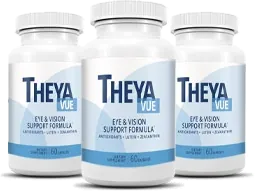
TheyaVue Reviews: How We Handle Ratings
This site shows only feedback from real buyers, so there is no TheyaVue star score here yet.
Instead, it explains what a trustworthy review includes and how to spot red flags on marketplaces. An eye exam is the only way to measure a real change in your sight.
For a fair wait time, see the TheyaVue results timeline.
Why this page has no star rating, no review count and no quotes
There is no star score, no review count and no customer quote anywhere on this site, and that is on purpose. The seller material we were handed for TheyaVue does include a rating, a count and several named quotes. Every one of them is marked in that material as layout copy: placeholder text dropped in while a page was being built, not feedback collected from anyone who actually bought a bottle.
We cannot turn placeholder text into a rating just because a number would look more finished at the top of this page. A score with no buyer behind it is not a smaller version of a real score. It is a different thing entirely, and printing it would tell you something false about how many people bought this and how they felt about it.
This is also why you will not find a review schema hidden in this page's code, or a small star icon tucked into a sidebar somewhere else on the site. Search engines and shoppers both read those signals as verified feedback, and neither of them deserves to be shown something that was never collected from an actual buyer in the first place.
A fabricated testimonial for a phone case just lies about a phone case. A fabricated testimonial for an eye supplement lies about someone's sight. It invents a person who says their vision got sharper, their floaters cleared up or their eye doctor was surprised at their next visit. None of that happened to anyone, because the person does not exist. That is the exact kind of harm this site was built to call out, and we are not going to commit a smaller version of it on our own review section. Regulators have gone after eye-supplement sellers for this before: the FTC settled with a marketer who claimed a supplement could restore vision lost to macular degeneration and cited fabricated recommendation figures Federal et al., 2005.
What a trustworthy supplement review actually contains
None of this is unique to eye products. It is the same checklist that separates a real review from a written one, for any supplement.
| What a real review would show | Why it matters |
|---|---|
| A verified-purchase tag tied to an actual order | Confirms a bottle changed hands before an opinion was posted |
| A date, not just a star count | Lets you see whether the account is a month old or five years old |
| A specific detail: how many bottles, how many weeks | Vague praise with no timeframe is the easiest kind to fake |
| At least one downside mentioned | Real buyers almost always have a small complaint; an unbroken chorus of praise is a warning sign |
| No claim about a diagnosed eye disease improving | A supplement review that reads like a medical outcome report is describing something a capsule cannot do |
| Wording that differs from the review next to it | Identical phrases across many names usually means one person, or one script, wrote all of them |
How to read marketplace reviews on an eye product
These four patterns show up on eye supplements as often as anywhere else, and they are worth checking before a rating changes your mind.
Vision restored, glasses ditched
A review claiming a bottle fixed a refractive error or reversed a diagnosed eye disease is describing something no capsule does. Treat that line as marketing that leaked into the review box, not as a result.
A wall of five stars, nothing else
A long run of five-star ratings with no text, or with text that reads like a slogan, is easier and cheaper to generate than a smaller mix of four and five stars with real complaints inside it.
The same three sentences, different names
Open ten reviews. If three of them share a sentence almost word for word, that sentence was written once and pasted, not lived through by ten separate people.
A photo that matches the listing photo
A genuine unboxing photo usually looks a little different from the product shot: a hand, a kitchen counter, a shipping label. A photo identical to the marketing image was not taken by a buyer.
What to record yourself, if you decide to try it
A personal log is not proof of anything to anyone else. It is still more honest than a memory, and it costs nothing to keep.
Write down where you are starting from
Note your current glasses or contact lens prescription and its date, and anything your last eye exam told you, before the first capsule.Log the two label cautions, not just the calendar
This label's niacin and biotin lines are worth tracking on their own; see the side effects page for what to watch for and when to call a clinician.Keep notes by week, not by feeling
A phone note with a date is more useful later than a general sense that things seem better, because memory smooths out the weeks in between.Book the next eye exam regardless of how you feel
Put it on the calendar before you start, not after you decide whether the bottle worked. A feeling is not a substitute for the appointment.
Why an eye exam is the only real measurement

An eye doctor has instruments that measure things a review cannot. A visual acuity chart, a tonometer for eye pressure, a dilated look at the retina and, in some clinics, an OCT scan of the macula are all objective readings taken the same way on the same person twice. A star rating is one person's memory of how their eyes felt over several weeks.
Even the research behind the carotenoids in this blend measures its effect with instruments, not with feelings. A pooled analysis of 46 studies on lutein and zeaxanthin tracked change in macular pigment optical density, a specific number read from specialized equipment, and still found the smaller intakes produced no measurable change over three to six months Wilson et al., 2021. If a lab measurement needs that much precision to show a small change, a written review of how someone's eyes felt is not going to catch anything more subtle than that.
The National Eye Institute is just as direct about the ceiling on what any of this can do: even the full AREDS2 formula, tested in a large clinical trial, slows disease progression in people who already have it and does not restore vision already lost National Eye Institute (NEI), 2025. A five-star quote could not prove more than that trial did, and this bottle is not that trial's formula in the first place. More on how the two compare is on the AREDS2 walkthrough.
A claim in a review is not the same as a confirmed result
Set any review claim next to the exam that could actually check it, and the gap becomes obvious.
| A review might say | What actually confirms it |
|---|---|
| "My vision is sharper now." | A visual acuity test, read the same way before and after |
| "Colors look more vivid." | Nothing a supplement review can substitute for; this is a subjective impression, not a measurement |
| "My eye doctor was surprised." | A comparison of two dated exam records from that same doctor, not a quote on a product page |
| "My floaters went away." | A dilated retinal exam; new or changing floaters are also a same-day reason to call an eye doctor |
| "I don't need reading glasses anymore." | A refraction test, since refractive error does not resolve from a capsule |
Reviews: common questions
Why doesn't this site show a star rating for TheyaVue?
The rating figure we were given is marked as layout copy in the seller material, not real buyer feedback, so we do not print it or any substitute number.
Are there any real customer quotes on this site?
No. No quote, review count or order count appears anywhere on this site, on this page or any other.
Isn't a placeholder rating better than no rating at all?
No. A number with no real buyer behind it tells you something false, and false is worse than blank.
Can I trust five-star reviews I see on a marketplace listing?
Some are genuine. Watch for claims about restored vision, walls of identical five-star text, and photos that match the listing image exactly, all covered above.
What should I track myself if I try the product?
Your starting prescription and exam notes, the label's niacin and biotin cautions, and a dated weekly log, then a scheduled eye exam regardless of how you feel.
Does a good review mean TheyaVue improves eyesight?
No review, real or not, can prove that. Blur has a specific cause, and TheyaVue is a support supplement, not a treatment for any of them.
Where can I check what the label itself actually says?
The Supplement Facts breakdown and the ingredient page both walk through the panel line by line, separate from any marketing claim.
Will this page ever show reviews in the future?
Only if we are given real, verifiable buyer feedback to publish. Nothing changes about that standard, no matter how the seller material we receive is formatted.
Keep reading
Side effects, limits and interactions
The niacin and biotin flags worth logging if you decide to try a bottle.
Read →The AREDS2 trial, explained fully
What the one large eye-supplement trial actually measured, and what it did not.
Read →What TheyaVue's seals do and don't verify
FDA registration, GMP and the marks on the bottle, read plainly.
Read →Order TheyaVue from the authorized retailer
60 servings per bottle, 1 to 2 droppers a day. Kits of 2, 3 or 6 bottles run from $39 a bottle on the sales page, with a 60-day money-back guarantee. Questions first? Call +1 (315) 724-2018.