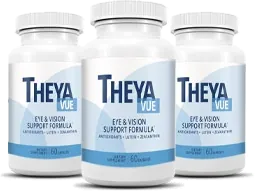
TheyaVue Benefits: What the Formula Supports
TheyaVue is made as an eye and vision support formula.
It combines zinc and copper with carotenoids such as lutein and zeaxanthin, nutrients with their own published research in eye health.
To see what goes into each capsule, read TheyaVue ingredients.
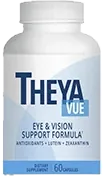
Three sources of claims, one bottle
A bottle of TheyaVue carries claims from three different places, and they are not equally reliable. Some come straight off the printed label. Some come from the sales page around it. Some are marketing seals with no certifier named. Sorting out which is which is the point of this page.
One thing does not change across any of them: nothing here is a promise about your eyesight. Not the label, not the seals, not the sales copy this site is built around. That distinction matters more for an eye product than almost any other kind of supplement, because the cost of believing an eye claim that is not true is a delayed appointment, not just a wasted bottle.
Five claims, loudest to quietest
Set out like an eye chart on purpose. Read down, and the type that governs everything above it gets smaller, not bigger.
- 1Doctor Developed
- 2FDA Registered Facility
- 3TheyaVue is for men and women who want natural, extra support for their eye and vision health
- 460 Capsules, Dietary Supplement
- 5Dietary supplement, not a drug. These statements have not been evaluated by the FDA. Not intended to diagnose, treat, cure, or prevent any disease. Not FDA-approved.
Set out like an eye chart on purpose. The claims get quieter as you read down, and the line that legally governs all of them is the one at the bottom in the smallest type. Anything struck through is a claim we are quoting in order to correct it.
Label wording versus seller wording
| Front label wording | Sales page wording |
|---|---|
| Eye & Vision Support Formula | Eye & Vision Support Formula |
| Antioxidants + Lutein + Zeaxanthin | Not repeated word for word on the sales page we were given |
| Dietary Supplement, 60 Capsules | TheyaVue is for men and women who want natural, extra support for their eye and vision health |
The label wording is a structure and function statement, the category US rules allow a supplement to use without pre-market proof: it may say a product supports a body part or function, but not that it treats, cures or prevents disease. The sales page wording sits in the same lane, just friendlier. Neither one is the funnel headline this site was built to answer, and that correction lives once, on the home page, not repeated here. A structure and function claim can be entirely true, as a description of ingredients, while still telling you nothing about whether those ingredients do anything measurable for the person taking them.
Why the line between "support" and "restore" is not just wording
Vision-restoration claims for eye supplements are a recognized category of deceptive advertising, not a gray area. In 2005 the Federal Trade Commission settled with the marketer of a supplement called "Ocular Nutrition," which had advertised that its product could "restore vision already lost from age-related macular degeneration" and "eliminate floaters," and had falsely claimed most ophthalmologists recommended it. The company paid $450,000 Federal et al., 2005.
That case is the reason a page like this one exists. A structure and function claim, such as "supports eye and vision health," is legal without pre-market proof under US rules, as long as it stops short of promising to treat, cure or restore anything. The moment a claim crosses into restoring lost vision, it moves from marketing language into the same territory that cost that company $450,000.
What the seals actually document
| Seal | What it actually documents |
|---|---|
| FDA Registered Facility | The plant appears on the FDA facility register. Registration is a listing, not an approval. |
| GMP Certified | Good Manufacturing Practice rules are claimed for the plant. No certificate number or auditing body is printed. |
| Doctor Developed | A marketing mark. No clinician is named in any material we were given. |
| Non-GMO, Gluten Free, Dairy Free | Descriptive marks from the seller artwork, with no certifying organization named next to any of them. |
A seal describes something about the product or the plant. None of the four above is evidence that the product works for anyone's eyes, and none carries the kind of certificate number a shopper could independently check.
What evidence actually backs any of this
What has real research behind it
Zinc's role alongside copper comes from AREDS2, a large randomized trial in people who already had macular degeneration Age-Related et al., 2013. Lutein and zeaxanthin's role in macular pigment has its own separate meta-analysis showing a dose-dependent effect Wilson et al., 2021. Both bodies of research support slowing disease progression in people who already have it. Neither supports this label's specific amounts, several of which are unpublished or below the trial dose.
What is marketing language with no evidence attached
"Doctor Developed" names no doctor. "Natural, extra support" describes a feeling, not an outcome. Seals for Non-GMO, gluten-free and dairy-free describe the product's makeup; they say nothing about whether it works for anyone's eyes.
The gap between those two columns is the real story of this bottle. Ingredient-level research exists, thin in places, absent in others; a finished-product trial does not. What each ingredient group is actually studied for is broken down on the how it works page, and the amounts themselves are on the ingredients page.
What normally backs a claim up, and is missing here
A claim is only as good as what stands behind it, and several things that would normally back a claim up are simply not printed here. No individual amount is given for lutein or zeaxanthin, the two ingredients named on the front of the bottle, so "Antioxidants + Lutein + Zeaxanthin" cannot be checked against any research dose. No third-party lab result accompanies the batch reference on the panel. No manufacturer or distributor address appears anywhere on the label we reviewed, which means there is no company name to check against a regulatory database beyond the seller itself.
None of that makes the product unsafe. It does mean a shopper is asked to take several claims on trust rather than checking them, which is a different thing from evidence, and worth knowing before you read the front of the bottle as a promise rather than as marketing copy built around a real, if incomplete, panel.
What this bottle never claims
- That it restores, sharpens or corrects eyesight.
- That it treats, slows or reverses macular degeneration, glaucoma, cataract, diabetic retinopathy or dry eye.
- That it reduces anyone's need for glasses, contacts or surgery.
- That any seal on the bottle was awarded by a named, checkable certifying body.
- That two capsules a day reproduce what AREDS2 tested, since four of the six comparable nutrients fall short of that trial's amounts.
Sudden blurring, flashes, floaters, eye pain or lost vision are reasons to call an eye doctor the same day, not reasons to reach for a capsule. Nothing sold on this site changes that, and nothing in the five claims above says otherwise either, once you read past the seal and into the fine print beneath it.
Benefits: common questions
Does TheyaVue claim to improve eyesight?
No. The strongest wording on the label and sales page is a support statement. No claim about sharpening, restoring or correcting sight appears on either.
What does "Eye & Vision Support Formula" actually mean legally?
It is a structure and function statement, a category US rules allow without pre-market proof, as long as it does not claim to treat or cure a disease.
Is "Doctor Developed" backed by a named clinician?
No. That mark appears in the seller artwork with no clinician named anywhere in the material we were given.
Do the Non-GMO, gluten-free and dairy-free seals mean anything is proven?
They describe the product's makeup. No certifying body or certificate number is printed beside any of them.
Is there real research behind any of this?
Some, unevenly. Zinc and copper, and lutein and zeaxanthin generally, have a genuine trial base. This label's specific amounts often fall short of, or cannot be compared to, that research.
What should I do if my vision changes suddenly?
See an eye doctor the same day. That is true regardless of anything printed on this bottle or this site.
Has any eye supplement been penalized for claims like these?
Yes. The FTC settled with the marketer of a different eye supplement in 2005 over claims that it could restore lost vision and eliminate floaters, and that company paid $450,000.
Why does this page keep separating label wording from sales page wording?
Because they carry different weight. The printed label is the legal document; sales page wording is marketing copy built around it, and the two do not always say the same thing.
Keep reading
What the ingredients are actually studied for
The research behind the carotenoids, zinc, copper, the antioxidant vitamins, the flavonoids and taurine.
Read →Every ingredient, inside and out
The fourteen itemised nutrients and the ten sharing the 240.5 mg blend, with amounts where they exist.
Read →Safety, limits and interactions
The niacin and zinc ceilings, biotin's lab-test warning, and the symptoms that mean an eye doctor, not a capsule.
Read →Order TheyaVue from the authorized retailer
60 servings per bottle, 1 to 2 droppers a day. Kits of 2, 3 or 6 bottles run from $39 a bottle on the sales page, with a 60-day money-back guarantee. Questions first? Call +1 (315) 724-2018.