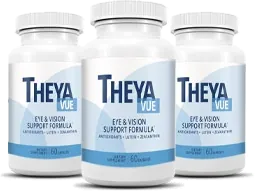
How Does TheyaVue Work? Its Ingredient Groups
TheyaVue works through several ingredient groups, each studied on its own.
Carotenoids are studied for macular pigment, zinc is paired with copper as in AREDS2, vitamins C and E act as antioxidants, and taurine is studied for retinal biology.
For dosing, see how to use TheyaVue.
What this page is, and what it is not
No clinical trial of TheyaVue itself exists. What follows is not a study of this capsule. It is a walk through five groups of ingredients on its panel, what each group is studied for in its own separate research, and whether the amount here plausibly reaches that research dose. Sometimes it does. More often, because the panel hides ten of the ingredients inside one 240.5 mg total, there is no way to know.
Treat every section below as two questions, not one: is there real research behind this ingredient, and does this particular bottle carry enough of it to matter. A yes to the first is not a yes to the second.
Macular pigment and the carotenoids
The macula, a small spot at the center of the retina, holds a yellow pigment built mostly from two carotenoids: lutein and zeaxanthin. A 2021 meta-analysis pooling 46 studies found daily intakes of 20 mg or more raised macular pigment density more than intakes between 5 and 20 mg, and doses under 5 mg a day showed no measurable change Wilson et al., 2021. The AREDS2 trial used 10 mg lutein plus 2 mg zeaxanthin a day National Eye Institute (NEI), 2025.
TheyaVue advertises both on the front of the bottle. Neither has a published amount, because both sit inside the undisclosed blend. Lutein leads that blend by weight and likely supplies the larger share, but "likely" is the honest word; nothing here can be checked against the 5 mg, 20 mg or any other line from the research.
Lycopene, a third carotenoid in the blend, has mostly epidemiological support for eye tissue, tracking blood levels rather than testing a dose Shafe et al., 2024. Its amount is unpublished too, and it sits last in the blend, which under labeling rules usually means the smallest share of the ten. The full ingredient-by-ingredient breakdown, including where each of the ten sits in the printed order, is on the ingredients page.
A fourth carotenoid, beta-carotene, supplies this label's vitamin A at a trace 50 mcg RAE a capsule. That is roughly a hundredth of the doses linked to higher lung cancer risk in smokers in two large trials, which is why AREDS2 dropped beta-carotene in favor of lutein and zeaxanthin National Institutes of Health, 2025. At this trace amount there is no established cancer concern, and no eye benefit either. More on that trade-off is on the side effects page.
Zinc and copper
Zinc is a genuine part of eye research, not a marketing add-on. It is one of the six nutrients in the AREDS2 formula, tested at 80 mg a day, with a lower 25 mg arm added later after the AREDS trial began exploring smaller doses Age-Related et al., 2013. This label supplies 32 mg a day as zinc oxide, a form absorbed at roughly half the rate of zinc citrate or gluconate National Institutes of Health, 2026. That puts it between the two AREDS2 arms in raw milligrams, though the oxide form means less of it is actually taken up.
Copper rides along at 2 mg a day, and that number is an exact match for AREDS2. It is there for a specific, well-documented reason: zinc at this range can lower copper absorption enough to cause a deficiency, so a real zinc-and-eye formula pairs the two National Institutes of Health, 2026. On this one point, the label follows the research correctly.
The antioxidant vitamins
Vitamin C and vitamin E are the other two AREDS2 nutrients on this panel, and both fall well short of the trial dose. AREDS2 used 500 mg of vitamin C a day; this label supplies 200 mg, or 40% of it National Institutes of Health, 2025. AREDS2 used 400 IU of vitamin E, about 180 mg of the synthetic form; this label supplies about 20 mg, roughly a ninth of the trial amount, as the synthetic DL-alpha form National Institutes of Health, 2021.
Both vitamins are real antioxidants studied for oxidative stress in retinal tissue generally, which is the theory behind including them at all. Neither amount here has been tested on its own for an eye outcome; they ride inside a formula built to resemble AREDS2 without matching its numbers.
The flavonoids, and two more single-study herbs
Four of the blend's ten ingredients are flavonoids or flavonoid-rich extracts: quercetin, rutin, grape seed extract and the anthocyanins in bilberry. All four are antioxidants in a laboratory sense. Human eye evidence for each is thin and uneven.
Quercetin is usually studied at 500 to 1,000 mg a day for general antioxidant effects; a 2017 review of quercetin and the eye found 44 registered human trials and not one that tested an eye disease McKay et al., 2017. A separate safety review flagged a lack of long-term data above 1,000 mg Andres et al., 2018. This entire blend totals 481 mg a day, for ten ingredients combined.
Rutin's human evidence traces back to a 1948 case report on diabetic retinopathy, before modern trial standards existed, and a 2023 review notes rutin absorbs poorly from the gut in the first place Tobar-Delgado et al., 2023. Grape seed extract has one real randomized trial, 150 mg a day for a year, that improved one finding in diabetic retinopathy Moon et al., 2019. Bilberry's wartime night-vision story, tracing to a myth about RAF pilots, was reviewed and not supported by controlled trials Canter et al., 2004. Two more blend members, alpha lipoic acid and eyebright, have their own single studies: ALA at 600 mg a day did not prevent diabetic macular edema in a two-year trial, a dose larger than this whole blend Haritoglou et al., 2011, and eyebright's only controlled human trial tested homeopathic eye drops, not the oral capsule form used here Drugs.com et al., 2026. None of the six has a published amount on this label.
Taurine
Taurine is a real, abundant part of a healthy retina, present at some of the highest concentrations of any tissue in the body, and a 2023 review describes it protecting retinal cells through antioxidant and anti-inflammatory pathways in animal and cell studies Duan et al., 2023. Human safety data go up to 3,000 mg a day with no adverse effects reported.
What that review does not supply is a human trial establishing an effective oral dose for a specific eye condition. Taurine belongs in this blend for a real biological reason, one of the stronger biological cases among the ten. It is still an unmeasured tenth of an unmeasured total, well under the 3,000 mg safety ceiling on its own, and there is no way to know how close it comes.
Why none of this is a trial of this bottle
Every citation above tests an ingredient, or a formula, that is not this bottle. AREDS2 tested six specific nutrients at six specific doses in people who already had macular degeneration. The quercetin and grape seed trials tested their own extracts at their own doses, for their own outcomes. None of them tested a 481 mg blend of ten ingredients in undisclosed proportions, because that blend, at those amounts, has never been the subject of a published trial.
That is not unusual for a supplement. It is worth saying plainly anyway: the research behind an ingredient is not the same claim as research behind this product, and nothing on this page should be read as the second thing. What the front label and the sales page are actually allowed to claim, given all of this, is sorted out on the benefits page. And none of it changes one rule: sudden blurring, flashes, floaters, eye pain or lost vision mean an eye doctor the same day, not a supplement.
How It Works: common questions
Has TheyaVue itself been tested in a clinical trial?
No. The research on this page covers individual ingredients, mostly at doses different from what this label supplies, not the finished product.
Which ingredient here has the strongest eye research?
Zinc, because it is one of the six AREDS2 nutrients. This label's 32 mg a day is still under the 80 mg AREDS2 tested.
Can lutein and zeaxanthin help my macular pigment at this dose?
Nobody can say. Both sit inside the undisclosed blend with no published amount, so the dose cannot be compared to the 5 mg, 10 mg or 20 mg thresholds seen in the research.
Why include copper alongside zinc?
Zinc at this range can lower copper absorption enough to cause a deficiency. Pairing the two, as AREDS2 did, is a documented safeguard, and this label's copper amount matches AREDS2 exactly.
Do the flavonoids in the blend have eye-specific human trials?
Barely. Quercetin's review found no human ocular trials at all; rutin's main evidence predates modern trial design; grape seed has one real randomized trial for a different eye complication.
Does any of this mean TheyaVue improves eyesight?
No. Nothing here is a vision-improvement claim, and no ingredient at any dose studied has been shown to sharpen sight or reverse an eye disease.
Keep reading
Every ingredient, inside and out
The fourteen itemised nutrients and the ten sharing the 240.5 mg blend, with amounts where they exist.
Read →The AREDS2 trial, explained fully
Who it was tested in, what it found, and how this label's zinc, copper, vitamin C and vitamin E compare.
Read →Safety, limits and interactions
The niacin and zinc ceilings, biotin's lab-test warning, and why an unpublished blend makes interactions harder to assess.
Read →Order TheyaVue from the authorized retailer
60 servings per bottle, 1 to 2 droppers a day. Kits of 2, 3 or 6 bottles run from $39 a bottle on the sales page, with a 60-day money-back guarantee. Questions first? Call +1 (315) 724-2018.