What Lutein Actually Does, and What It Does Not
Lutein and zeaxanthin are plant pigments that concentrate in the retina's macula, linked to macular pigment density and blue-light filtering. AREDS2 tested 10 mg lutein plus 2 mg zeaxanthin daily in people who already had macular degeneration, finding a small pigment change over months. Neither compound sharpens eyesight, and a front label naming lutein with no amount cannot be compared to that research.
What lutein and zeaxanthin actually are
Lutein and zeaxanthin are the two carotenoids named on the front of more eye-support bottles than almost any other ingredient, including the one this site covers. Both are yellow-orange plant pigments, part of a family called xanthophyll carotenoids, and both concentrate in one very specific place in the human body: the macula, the small central part of the retina responsible for sharp, detailed vision.
Unlike most carotenoids, the body cannot make lutein or zeaxanthin on its own. They arrive only through diet or a supplement, get absorbed with dietary fat, and travel through the bloodstream to a small number of tissues that selectively pull them out of circulation, the retina being the main one worth discussing here.
This article is about what these two compounds are, where the research on them actually points, and where it stops. It is not about sharpening eyesight. No dose of either compound, in any study referenced here, has been shown to improve visual acuity, and nothing below should be read as implying otherwise.
Macular pigment, and what it has to do with blue light
The macula owes part of its yellow color to lutein and zeaxanthin sitting inside it, a deposit researchers call macular pigment. Its density can be measured with a non-invasive optical test, usually reported as macular pigment optical density, or MPOD.
Macular pigment sits directly in front of the light-sensing cells of the macula and absorbs a portion of incoming blue light before it reaches them. Blue light is the higher-energy, shorter-wavelength end of visible light, and the working theory behind macular pigment is that filtering some of it out, along with the antioxidant behavior of the pigment itself, may reduce oxidative stress on the retina over time.
Filtering blue light and improving how well someone sees are two different claims. Macular pigment density is a measurable biological quantity. A change in that quantity is not the same thing as a change in what a person can read on an eye chart, and the research below treats them separately for exactly that reason.
Macular pigment builds up over months, not minutes, which is why every serious study on this topic reports its results at multi-month intervals rather than days or weeks. That timing detail matters enough to get its own section further down.
Where they come from in food
| Food | Why it shows up in this conversation | Rough carotenoid content |
|---|---|---|
| Kale, cooked | One of the richest common dietary sources of lutein and zeaxanthin combined | Several times higher per serving than most other vegetables |
| Spinach, cooked | A close second to kale, and far more commonly eaten in everyday meals | High, and consistently cited in dietary intake studies |
| Egg yolk | A smaller amount of carotenoid, but delivered already dissolved in fat | Lower per serving, with comparatively easy absorption |
| Corn, orange peppers, and other yellow-orange produce | Contribute smaller amounts, usually alongside other carotenoids | Moderate, and highly variable by preparation |
Dark leafy greens supply most of the lutein and zeaxanthin in a typical diet, with kale and spinach at the top of nearly every food-composition list. Egg yolk supplies less by weight, but its fat content is thought to help the carotenoids already dissolved in it get absorbed efficiently.
Because both compounds are fat-soluble, eating them alongside any dietary fat, whether that is olive oil on a salad or the fat naturally in an egg, generally helps absorption more than eating the same vegetable completely plain.
A supplement capsule is trying to shortcut this same pathway: deliver a measured amount of lutein and zeaxanthin without requiring a specific serving of greens. Whether a given capsule actually discloses that measured amount is a separate question, addressed further down.
The amounts used in the one major eye trial: 10 mg and 2 mg
The most-cited human trial involving lutein and zeaxanthin is AREDS2, a large randomized trial run by the National Eye Institute. It tested adding 10 mg of lutein and 2 mg of zeaxanthin, 12 mg combined, to an existing formula of vitamin C, vitamin E, zinc and copper, in people who already had intermediate or advanced age-related macular degeneration (Age-Related et al., 2013).
| Detail | AREDS2 trial |
|---|---|
| Who was enrolled | People already diagnosed with intermediate or advanced AMD, or advanced AMD in one eye |
| Lutein dose tested | 10 mg a day |
| Zeaxanthin dose tested | 2 mg a day |
| What it was tested against | Progression to advanced AMD over roughly five years, later extended to ten |
| What it was not tested for | Preventing AMD in healthy eyes, helping early AMD, or improving visual acuity |
A ten-year follow-on analysis found lutein and zeaxanthin performed at least as well as the beta-carotene they eventually replaced in the formula, while carrying a lower lung cancer signal in the people who had smoked (AREDS2 et al., 2022). The National Eye Institute is direct about the limits of that result: it can help slow progression in people who already have the disease, and it does not benefit people with early or no AMD, and it does not restore vision already lost (National Eye Institute (NEI), 2025).
What the research supports, and what it does not
A 2021 systematic review pooling 46 studies and more than 3,000 participants looked specifically at what different daily amounts of lutein and zeaxanthin do to macular pigment optical density. Intakes under 5 mg a day produced no significant change. Intakes between 5 and just under 20 mg a day increased macular pigment by a small, measurable amount. Intakes of 20 mg a day or more produced a larger increase (Wilson et al., 2021).
A daily intake in the range AREDS2 used is associated with a small increase in macular pigment density, measured over months, in the population that trial studied. That is a real, replicated finding. It is a finding about pigment density, not about sharpness of vision.
No study referenced here shows lutein or zeaxanthin, at any dose, improving visual acuity, correcting a refractive error, reversing macular degeneration, or preventing AMD in someone who does not already have it. The clinical significance of the pigment change itself, for someone with healthy eyes, remains an open question even in the research that found it.
It is also worth remembering why lutein and zeaxanthin entered the AREDS formula at all: the original AREDS formula used beta-carotene, and two earlier trials found that beta-carotene supplements raised lung cancer risk specifically in smokers and former smokers. AREDS2 tested lutein and zeaxanthin partly as a safer substitute for that ingredient, not because either one had already been proven to sharpen sight on its own.
Why "contains lutein" on a front label tells you nothing on its own
"Contains lutein" and "10 mg of lutein" are two different statements, and only one of them lets you compare a bottle to any research at all. A front label naming an ingredient with no number attached tells you it is present in some amount, which could be a meaningful dose or a token amount, and there is no way to tell which from the front of the bottle alone.
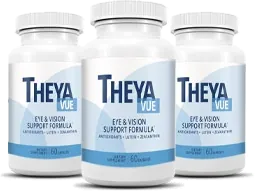
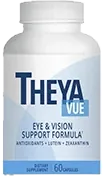
TheyaVue is a case in point. The front reads "Antioxidants + Lutein + Zeaxanthin." On the back, both sit inside a single 240.5 mg proprietary blend that also contains eight other ingredients, and no individual amount is printed for any of the ten. Lutein is listed first in that blend, and under the labeling convention that orders a blend heaviest to lightest, that means it is the largest single component of the ten, not that it reaches any particular milligram figure.
Without a published amount, a bottle’s lutein and zeaxanthin cannot be placed anywhere on the dose scale discussed above. It could fall under the 5 mg a day floor where the 2021 meta-analysis found no measurable change, it could land in the 5-to-20 mg range associated with a small effect, or anywhere in between. A front label naming the ingredient answers whether it is present. It does not answer how much, and how much is the only number that connects a bottle to the research behind it.
The full ten-ingredient breakdown, including what each one is separately studied for, is on the ingredients page; how this specific blend stacks up against the AREDS2 benchmark is on the AREDS2 walkthrough.
How long a measurable change actually takes
Macular pigment does not shift in a day, and studies of it are not designed to catch a day-to-day change. The 2021 meta-analysis pooling 46 studies reported its findings at intervals of three to six months, which is the timeframe over which macular pigment optical density has actually been shown to move in response to intake.
| Timeframe | What is realistic to expect |
|---|---|
| Days to a few weeks | No measurable change in macular pigment. This is far too short a window for any study reviewed here to detect anything. |
| One to three months | The earliest point most trials even attempt a measurement, and results at this stage are inconsistent across studies. |
| Three to six months | The interval most commonly used in the research pooled above, and the point at which a small increase becomes detectable at the doses studied. |
| Beyond six months | Longer follow-on work, such as the ten-year AREDS2 analysis, tracks disease progression rather than pigment density directly. |
None of this is measured with a home test. Macular pigment optical density requires specialized optical equipment found in eye clinics and research settings, not something a person can check on their own between appointments. A supplement working exactly as the research above describes would still produce nothing a person could notice or verify without that equipment, and it would still not be a change in how well they see.
For a broader look at how eye-supplement marketing tends to compress a months-long biological process into an overnight promise, see the red flags in eye-supplement marketing, and for what the AREDS2 comparison looks like once a panel is read at the real daily dose, see reading a label per capsule versus per day.
Questions readers ask
Are lutein and zeaxanthin the same thing?
No. They are related xanthophyll carotenoids that both concentrate in the retina's macula, but they are distinct compounds, usually studied and dosed together rather than separately.
Can the body make its own lutein or zeaxanthin?
No. Both come only from diet or a supplement. The body absorbs them with dietary fat and selectively deposits them in a small number of tissues, the retina being the main one discussed here.
What foods have the most lutein and zeaxanthin?
Dark leafy greens lead the list, with cooked kale and spinach among the richest common sources. Egg yolk supplies a smaller amount, delivered already dissolved in fat.
What dose did the AREDS2 trial actually use?
10 mg of lutein and 2 mg of zeaxanthin a day, 12 mg combined, added to an existing formula of vitamin C, vitamin E, zinc and copper, tested only in people who already had intermediate or advanced AMD.
Does taking lutein improve eyesight?
No study referenced here shows that. The research supports a small, slow change in macular pigment density in people who already have AMD. It does not support improved visual acuity in anyone.
Why does a front label naming lutein not tell me much?
Because it says the ingredient is present, not how much. Without a milligram amount, there is no way to compare a bottle to the doses used in the research, including the 10 mg and 2 mg AREDS2 tested.
How long would it take to notice a difference in macular pigment?
Research on this measures change over three to six months at minimum, using specialized optical equipment found in eye clinics. It is not something a person can check or feel on their own.
Is lutein the same as beta-carotene?
No. Both are carotenoids, but AREDS2 specifically tested lutein and zeaxanthin as a substitute for beta-carotene, after earlier trials linked high-dose beta-carotene supplements to increased lung cancer risk in smokers.
Keep reading
Claims that should stop you
Eye-supplement red flags: restoration promises, trick framing, invented doctors, before-and-after charts, testimonials, ...
Read →Per capsule versus per day
What Serving Size legally means, why a per-capsule panel halves every percentage on a twice-daily product, and how it ch...
Read →How much does TheyaVue cost?
Pack sizes, days of supply and how to pick the right one.
Read →Order TheyaVue from the authorized retailer
60 servings per bottle, 1 to 2 droppers a day. Kits of 2, 3 or 6 bottles run from $39 a bottle on the sales page, with a 60-day money-back guarantee. Questions first? Call +1 (315) 724-2018.