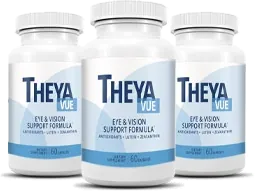
TheyaVue Supplement Facts: The Panel Line by Line
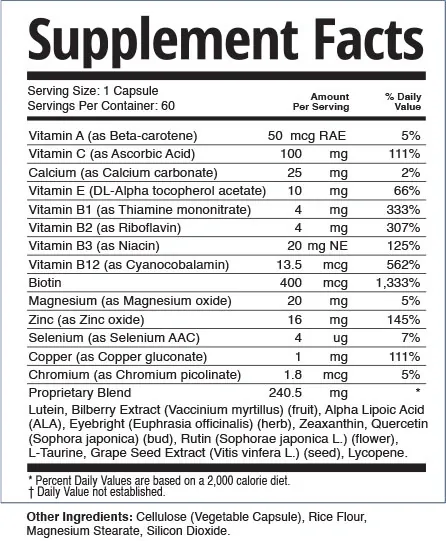
The TheyaVue panel lists a 1-capsule serving and 60 servings per container.
The directions ask for two capsules a day, so a bottle lasts 30 days and every %DV shown is per capsule. Minerals include zinc oxide and magnesium oxide.
For the daily routine, see how to use TheyaVue.
Serving size says one. Directions say two.
Two sentences on the same package, and only one of them describes what you will actually take.
The top of the TheyaVue panel says Serving Size: 1 Capsule, Servings Per Container: 60. Read no further and a bottle looks like a 60-day supply. The Directions line, printed separately below the panel, asks for one capsule twice daily, 20-30 minutes before a meal with an 8 oz glass of water. Two servings a day means every number above doubles, and 60 capsules becomes a 30-day bottle.
That gap between the serving size and the directions is the single most useful thing to notice before opening the box. None of it changes one rule: sudden blurring, flashes, floaters, eye pain or lost vision mean an eye doctor the same day, not a dose adjustment.
Before a meal or after? The label and the listings disagree
One more small gap between what is printed and what gets repeated elsewhere.
What the label prints
“For best results, take one (1) veggie capsule twice daily, 20-30 minutes before a meal with an 8 oz. glass of water.” That is the printed direction, and it says before a meal.
What some listings say
Some listings describe taking it after a meal. The label says before one, and the label is what we follow.
Which one wins
The physical label is the legal document. When a published listing disagrees with it, we follow the label, and so should you.
The whole panel, per capsule and per day
The label prints the left column only. Here is what following the directions actually adds up to.
| Nutrient | Per capsule | % DV per capsule | Per day, two capsules |
|---|---|---|---|
| Vitamin A (as Beta-carotene) | 50 mcg RAE | 5% | 100 mcg RAE |
| Vitamin C (as Ascorbic Acid) | 100 mg | 111% | 200 mg |
| Calcium (as Calcium carbonate) | 25 mg | 2% | 50 mg |
| Vitamin E (as DL-Alpha tocopherol acetate) | 10 mg | 66% | 20 mg |
| Vitamin B1 (as Thiamine mononitrate) | 4 mg | 333% | 8 mg |
| Vitamin B2 (as Riboflavin) | 4 mg | 307% | 8 mg |
| Vitamin B3 (as Niacin) | 20 mg NE | 125% | 40 mg NE |
| Vitamin B12 (as Cyanocobalamin) | 13.5 mcg | 562% | 27 mcg |
| Biotin | 400 mcg | 1,333% | 800 mcg |
| Magnesium (as Magnesium oxide) | 20 mg | 5% | 40 mg |
| Zinc (as Zinc oxide) | 16 mg | 145% | 32 mg |
| Selenium (as Selenium AAC) | 4 mcg | 7% | 8 mcg |
| Copper (as Copper gluconate) | 1 mg | 111% | 2 mg |
| Chromium (as Chromium picolinate) | 1.8 mcg | 5% | 3.6 mcg |
| Proprietary Blend | 240.5 mg | † | 481 mg |
The percentages printed on the bottle belong to the left column. The column on the right is what you actually swallow in a day if you follow the directions, and no percentage is printed for it anywhere.
The panel, tapped one line at a time
- 1. One capsule is one serving, and you take twoEvery figure on this panel is per capsule. The directions ask for two a day, so the real daily intake is double, and a 60-capsule bottle is 30 days.
- 2. Vitamin C, 100 mg a capsuleThat is 200 mg a day. The AREDS2 eye trial used 500 mg a day, so this is about two fifths of it.
- 3. Niacin, 20 mg NE a capsuleForty milligrams a day, above the 35 mg upper limit set for supplemental niacin. The panel does not say which form it uses.
- 4. Biotin, 400 mcg a capsuleEight hundred micrograms a day. Biotin can skew common blood tests, so tell any clinic drawing your blood.
- 5. Zinc, 16 mg a capsuleThirty-two milligrams a day, inside the 40 mg adult upper limit but worth counting if you take other supplements.
- 6. One 240.5 mg blend for ten thingsLutein and zeaxanthin are printed on the front of the bottle. Neither gets an amount here; both sit inside this single total.
- 7. Other ingredientsCellulose for the vegetable capsule, plus rice flour, magnesium stearate and silicon dioxide.
Reading %DV and the dagger symbol
What %DV means here
Percent Daily Value compares one nutrient to a 2,000-calorie reference diet. It is a useful yardstick for the fourteen itemised lines, and it is calculated per capsule, not per day, which is why it needs doubling before it means anything about your actual intake.
What the dagger (†) means
Next to the Proprietary Blend, the dagger points to a footnote reading Daily Value not established. No government reference amount exists for a 481 mg mix of ten different plant compounds and an amino acid, so no percentage can be printed there, correctly.
Biotin shows the doubling most clearly: the panel prints 1,333% per capsule. Take the second capsule the directions ask for and the true daily figure is 2,667% of the reference amount, a number that appears nowhere on the bottle. None of this makes biotin dangerous on its own National Institutes of Health, 2022; it just means the printed percentage is not the one you should be doing mental math with. The same doubling applies to every line above the blend, and it is worked through fully on the per-capsule-versus-per-day post.
Five minerals, five different chemical forms
| Mineral | Form on the label | What that form means |
|---|---|---|
| Calcium | Calcium carbonate | A common, inexpensive calcium salt. Absorbs best taken with food, which the directions already ask for. |
| Magnesium | Magnesium oxide | One of the least bioavailable magnesium forms sold National Institutes of Health, 2026; a meaningful share is thought to pass through unabsorbed. |
| Zinc | Zinc oxide | About 50% absorbed versus roughly 61% for zinc citrate or gluconate National Institutes of Health, 2026. |
| Copper | Copper gluconate | A well-absorbed, commonly used copper salt, and the one mineral form here with no absorption flag. |
| Selenium | Selenium AAC (amino acid chelate) | A chelated form bound to an amino acid, generally considered easy for the body to take up. |
Two of five forms here, zinc oxide and magnesium oxide, are among the weaker absorbed choices available. Neither is unsafe; both simply deliver less of the printed number into your bloodstream than a pricier salt would. Cost, not absorption, is usually why a formula picks the oxide form: it is cheap, stable on a shelf, and lets the label print a bigger milligram figure for the same manufacturing cost, even though the body ends up keeping a smaller share of it.
What "Other Ingredients" actually means
The panel closes with a short line: Other Ingredients: Cellulose (Vegetable Capsule), Rice Flour, Magnesium Stearate, Silicon Dioxide. None of these four are active nutrients. Cellulose builds the vegetable capsule shell itself. Rice flour is a filler that gives the powder inside enough bulk to fill that shell evenly. Magnesium stearate helps the capsule machinery run without the powder sticking. Silicon dioxide keeps the powder from clumping. The panel prints no allergen statement beneath this line, and no parts-per-million threshold for any of the gluten-free or dairy-free marks used elsewhere in the seller artwork. If a genuine allergy is in play, that gap matters more than a marketing seal does, and it is worth a call to the order desk before you rely on the artwork alone.
Who the panel does not name
The panel image we were given carries no manufacturer name, no distributor address and no country of manufacture. The panel image carries no distributor block, so no manufacturer address is published. That is unusual among supplement labels, which typically carry a "Distributed by" or "Manufactured for" line near the bottom.
Mytheyavue, the company behind this website, is a U.S. stocking partner for TheyaVue, not the manufacturer, with an office at 757 Third Avenue, Floor 14, New York, NY 10017, USA. That address belongs to the seller of this site, not to whoever fills the capsules, and the panel itself does not say who that is. More on how this site is run sits on the about page, and what the missing pieces mean for trusting this label lives on the testing and quality page.
Supplement Facts: common questions
Is a TheyaVue bottle really a 30-day supply?
Yes. The panel counts 60 servings of one capsule, but the directions ask for two capsules a day, which uses the bottle in 30 days.
What does the dagger symbol next to the blend mean?
It marks a footnote reading "Daily Value not established," which is why no percentage is printed for the Proprietary Blend.
Why do the %DV figures look so high for biotin and B12?
Because they are calculated per capsule against small daily reference amounts. Take the second capsule and the real percentage is double what is printed.
Are zinc oxide and magnesium oxide good forms?
They work, but both absorb less efficiently than some other mineral salts. Neither form is unsafe at this label's amounts.
Does the label say who manufactures TheyaVue?
No. The panel we reviewed has no manufacturer name, distributor address or country of manufacture printed on it.
What are the Other Ingredients for?
Cellulose forms the capsule shell; rice flour, magnesium stearate and silicon dioxide are fillers and processing aids, not active nutrients.
Keep reading
Every ingredient, inside and out
The fourteen itemised nutrients and the ten sharing the 240.5 mg blend, with the research behind each one.
Read →What each part is actually studied for
Macular pigment, the mineral pairing, the antioxidant vitamins and more, measured against what this label supplies.
Read →Limits, interactions and red flags
The niacin and zinc ceilings, biotin's lab-test warning, and the symptoms that mean an eye doctor visit, not a capsule.
Read →Order TheyaVue from the authorized retailer
60 servings per bottle, 1 to 2 droppers a day. Kits of 2, 3 or 6 bottles run from $39 a bottle on the sales page, with a 60-day money-back guarantee. Questions first? Call +1 (315) 724-2018.