TheyaVue Before and After: 5 Checks on Photos and Stories
Not much. Sight cannot be shown in a photo, and this site holds no verified before and after photos, customer stories or review scores for TheyaVue. The research behind its ingredients measures eye tissue over months, not sharper sight. Five checks below help you judge any story you meet, and build your own record.
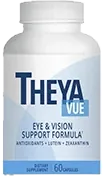
What does a TheyaVue before and after story really show?
You may have typed TheyaVue before and after or TheyaVue results into a search box. You probably hoped to see a clear photo or a short story with a number. We looked for one we could stand behind. We found none, and this page explains why that matters.
A before and after story sells because it feels like proof. One person, one change, one product. But eyesight is not like weight or skin. A camera cannot see how well someone reads a chart. So the stories you meet online are usually words, and words are easy to write.
This page does not tell you the capsule fails or works. It gives you five checks to run on any story, and it shows what the published research can and cannot support. We use only the label, the seller notes and the sources named in our files.
- This site publishes no customer reviews, star scores, photos or before and after stories. The figures supplied to us were marked as layout copy, so they could not be verified.
- One sales funnel headline says a 3-second finger trick restores blurry eyesight to 20/20. That is marketing. No evidence supports it, and no supplement restores eyesight.
- In the AREDS2 trial, a fixed formula slowed the disease only for people who already had a middle or late stage of macular degeneration. Nobody's sight got sharper.
- Macular pigment studies pooled in a 2021 meta-analysis mostly ran three to six months.
- The 60-day guarantee starts on the purchase date. It is a rule about buying, not a promise about health.
If you would rather read the real label, price and 60-day terms than a stranger's story, the order page shows them in one place.
See today's price and guaranteeMytheyavue earns money when you buy through the order links on this site.
TheyaVue is a dietary supplement. It is not FDA approved, and no supplement is. It is not intended to diagnose, treat, cure or prevent any disease, and no supplement restores eyesight. Individual results vary. Ask your doctor before use if you take medicine or have a medical condition. Sudden blurring, flashes, floaters, eye pain or vision loss need an eye doctor the same day.
Check 1: Who is in the photo, and can you check it?
Start with the plain question. Is there a name, a date, an order and a way to ask follow-up questions? A photo with a first name and a city is not a record. Anyone can type those.
Our files hold review figures for this product, including scores and order counts. They were marked as layout copy. That means they were placed on a page to show how a page might look. They were not collected from real buyers. So this site does not publish them, and we do not quote any of them here.
When a page shows a smiling face, a score and a count, ask which of the three you could check. If the answer is none, treat the whole box as decoration.
- Is the person named, and can you reach them?
- Is there a date, an order or a purchase link tied to the story?
- Does the story say what did not go well, as real stories often do?
- Is the same wording copied on other pages? Repeated lines are a warning sign.
Check 2: Can a photo show better eyesight at all?
A photo can show a face. It cannot show how clearly that face sees. Sight is measured with a chart, a lens test and instruments in an eye exam. None of those fit in a picture.
So a before and after photo for an eye product can only show something else, like a different light, a new pair of glasses or a different mood. It can look like proof when it is not.
What a person can honestly report is a feeling. Feelings matter, but they are not the same as a measured change. The research we cite measures eye tissue with instruments. It does not rest on how someone feels in the mirror.
Treat a photo as a story about a person, not as a test of a product. Ask what was measured, by whom and when. If the page cannot answer, the photo adds nothing.
Check 3: Is the time frame believable?
Time is where many results stories fall apart. The main carotenoid research we hold, a 2021 meta-analysis of macular pigment, mostly covers three to six months of intake. The change it measured was in eye tissue, and the size of the change depended on the daily amount taken.
That same analysis found no significant effect below 5 mg a day and a larger effect at 20 mg a day or more than at 5 to 20 mg a day. This label does not publish an amount for lutein or zeaxanthin, so a reader cannot place TheyaVue on that scale.
Now compare that with a story that says the change came in a few days. The research does not describe a change that fast. The honest first week is about the habit, which means two capsules a day, 20-30 minutes before a meal, with 8 oz of water.
| Point in time | What the research supports | What a story should not claim |
|---|---|---|
| Week 1 | Building the routine | A change in sight |
| Weeks 4-8 | Still early for the carotenoid question | Proof the product works |
| Weeks 8-12 | Where macular pigment studies begin to report | Sharper vision from a pigment change |
| Your next eye exam | The only real measurement | Anything an exam did not record |
Check 4: Does the claim match what the trial found?
The most famous eye supplement trial is AREDS2. Its volunteers all had a middle or late stage of age-related macular degeneration when they joined. In that group, one set formula slowed how fast the disease got worse. It did not sharpen anyone's sight. It showed no benefit for people with early disease or none.
TheyaVue is not that formula. Of the six AREDS2 nutrients, this label matches only copper. The label gives less vitamin C, vitamin E and zinc than the trial did, and it prints no amount at all for lutein or zeaxanthin. So a story that leans on AREDS2 to promise a clear before and after is stretching the trial in two ways.
Then there is the finger trick headline from one sales funnel, which promises to restore blurry eyesight to 20/20. Our files call it unsupported marketing. The US Federal Trade Commission has acted before on this kind of claim. In 2005 a seller of an eye supplement that advertised it could treat eye disease settled FTC charges and paid $450,000.
You do not need to accuse anyone. You only need to notice when a promise is bigger than the proof behind it.
Check 5: How can you build your own before and after record?
A better record is one you keep yourself. It will not prove the capsule works, because many things change eye health over months. But it keeps you honest and gives your eye doctor something real to read.
Write the start date and the kit
Note the day you began and which kit you bought. The 60-day guarantee counts from the purchase date, so also note that date.
Tick each day you took both capsules
Habit is the one thing you fully control. The label asks for one capsule twice a day, before a meal, with water.
Log sudden changes in a separate list
Sudden blurring, flashes, floaters, eye pain or vision loss are not data points for a supplement. They mean an eye doctor the same day.
Book your next eye exam
An optometrist or ophthalmologist has instruments that a mirror and a feeling do not. That visit is the real measurement.
Decide on the guarantee before it closes
The 60-day window ends before the three to six month research clock does. Choose with that gap in mind, and call the order desk on +1 (315) 724-2018 if you want to return the order.
Keep the order email too. It holds the order ID that the desk needs for tracking, a return or a refund.
What facts can you actually compare?
Since stories are weak evidence, lean on the facts that are printed. They do not change with the mood of the writer.
| Item | What is printed or published |
|---|---|
| Form | 60 vegetable capsules, a dietary supplement |
| Directions | One capsule twice daily, 20-30 minutes before a meal, with an 8 oz glass of water |
| Supply | 30 days per bottle at two capsules a day |
| Price | $59 for 1 bottle, $147 for 3 bottles, $234 for 6 bottles |
| Guarantee | 60 days from the purchase date; the buyer pays return shipping |
| Lutein and zeaxanthin | Advertised on the front, amount not published |
| Third-party lab report | Not published |
| Verified customer reviews | Not published |
Frequently asked questions
Are there real TheyaVue before and after photos?
We hold none that we can verify, and this site publishes none. Sight cannot be shown in a photo, so any picture would say little about eyesight.
Why does this site show no TheyaVue reviews or star scores?
The review figures supplied to us were marked as layout copy, so they could not be verified. We would rather publish none than publish numbers we cannot stand behind.
What results can I expect from TheyaVue?
No result is promised. The research on its ingredients measures eye tissue over three to six months, and the label does not publish the lutein or zeaxanthin amount. Individual results vary.
Can TheyaVue restore my eyesight to 20/20?
No. A sales funnel headline makes that claim, but no evidence supports it and no supplement restores eyesight.
How long before I should judge TheyaVue?
Week 1 shows only whether the routine sticks. Macular pigment research usually reports after three to six months, which is longer than the 60-day guarantee. Your eye exam is the real measure.
What if my sight changes fast while I take it?
See an eye doctor the same day. Sudden blurring, flashes, floaters, eye pain or vision loss are not a reason to wait and see whether a supplement helps.
Which sources back this page?
- AREDS2 Research Group (2013). Lutein + Zeaxanthin and Omega-3 Fatty Acids for Age-Related Macular Degeneration: the AREDS2 Randomized Clinical Trial. JAMA.
- AREDS2 Research Group (2022). Long-term Outcomes of Adding Lutein/Zeaxanthin and omega-3 Fatty Acids to the AREDS Supplements on AMD Progression (Report 28). JAMA Ophthalmology.
- National Eye Institute (2025). About AREDS and AREDS2.
- Federal Trade Commission (2005). Seller of an eye-health dietary supplement that purports to treat eye diseases settles FTC charges and pays $450,000.
- Wilson LM et al. (2021). The Effect of Lutein/Zeaxanthin Intake on Human Macular Pigment Optical Density: A Systematic Review and Meta-Analysis. Advances in Nutrition.
- Canter PH, Ernst E (2004). Anthocyanosides of Vaccinium myrtillus (Bilberry) for Night Vision: A Systematic Review of Placebo-Controlled Trials. Survey of Ophthalmology.
- Reviews page (this site)
- A realistic TheyaVue results timeline (this site)
- AREDS2 explained (this site)
Our view
A before and after story is the oldest sales tool there is, and eye products lean on it hard because the real change is hard to see. We do not publish any, and we do not say that is a loss. It is the honest position from the files we hold.
If you decide to try TheyaVue, treat it as a daily habit with unknown carotenoid amounts, not as a promise. Keep your own record, keep your eye exams, and see a doctor at once for any sudden change. Use the 60-day guarantee as a safety net, and know that it ends before the research clock would.
Whatever you decide, check the label, the price and the return terms yourself on the order page.
See today's price and guaranteeMytheyavue earns money when you buy through the order links on this site.