How Much Lutein and Zeaxanthin a Day? 5 Steps to Read a Label
The research lines are these: AREDS2 used 10 mg lutein plus 2 mg zeaxanthin a day, and a 2021 review found intakes of 20 mg or more moved macular pigment more than 5-20 mg, with no clear change under 5 mg. TheyaVue prints no lutein or zeaxanthin amount, so it cannot be placed on that scale.
How much lutein and zeaxanthin should you get a day?
Searches such as how much lutein a day, lutein daily intake, recommended dosage of lutein and zeaxanthin and zeaxanthin daily requirement all ask for a single number. We wish we could give you one. Our sources do not publish an official daily requirement for either carotenoid, and we will not make one up.
What the sources do give is a set of research reference points. They are not rules and they are not advice for your body. They are markers that let you read any label, including the TheyaVue label, with a straight face.
Here are five steps. Each one is something you can do with the bottle in your hand and a pencil.
- AREDS2 used 10 mg of lutein and 2 mg of zeaxanthin a day, 12 mg together, in people who already had macular degeneration.
- A 2021 meta-analysis found intakes of 20 mg a day or more raised macular pigment more than 5-20 mg, with no significant change below 5 mg.
- TheyaVue lists lutein and zeaxanthin inside a 240.5 mg blend per capsule, 481 mg a day, with no separate amounts.
- A daily requirement for either carotenoid is not published in the sources we hold.
- Label direction for TheyaVue: one capsule twice a day, 20-30 minutes before a meal, with 8 oz of water.
Want to see the whole TheyaVue panel and the kit options side by side before you read on? The order page lists both.
See today's price and guaranteeMytheyavue earns money when you buy through the order links on this site.
These are research reference points, not a dose for you. TheyaVue is a dietary supplement, not FDA approved, and not a treatment for any eye disease. Ask a doctor or an eye doctor what suits you, especially if you take medicine or already use another eye formula.
Step 1: Where is the lutein line on the label?
On a clear label, lutein has a line of its own with a number in milligrams. On the TheyaVue panel there is no such line. Lutein is the first of ten ingredients in a Proprietary Blend, and the blend is printed as one total: 240.5 mg per capsule.
At two capsules a day, that is 481 mg for the whole blend. Inside the blend, label order runs lutein first, then bilberry extract, alpha lipoic acid, eyebright, zeaxanthin, quercetin, rutin, L-taurine and grape seed extract, with lycopene last.
Blend order is a rank from most to least by weight. If the 481 mg were split evenly, each ingredient would get about 48 mg. Nobody outside the factory knows how it is actually divided, so treat that as an exercise and not as a fact.
Step 2: Where is the zeaxanthin line?
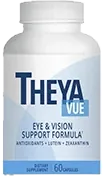
It is also inside the blend, fifth in the list, with no amount. The front of the bottle says Antioxidants + Lutein + Zeaxanthin, so both are advertised in large type and measured nowhere on the back.
That mismatch is the single most important thing to notice. A front-label claim with no back-label number is a promise you cannot check. The order desk on +1 (315) 724-2018 is the place to ask whether the maker can share the amounts. We have no answer to print.
Step 3: What are the research lines?
Three reference points matter. They come from the AREDS2 trial and from a 2021 systematic review and meta-analysis of lutein and zeaxanthin intake and macular pigment density.
| Reference point | Amount a day | What it is |
|---|---|---|
| Under 5 mg | Below 5 mg | No significant change in macular pigment in the pooled studies |
| Middle range | 5-20 mg | Some change, smaller than at higher intakes |
| Higher range | 20 mg or more | A larger change in macular pigment in the pooled studies |
| AREDS2 formula | 10 mg lutein plus 2 mg zeaxanthin | Tested in people with intermediate or advanced macular degeneration |
| TheyaVue label | Not published | Both sit inside the 481 mg daily blend |
Two cautions go with this table. First, macular pigment density is a tissue measure, not a sight test. No trial in this body of research equates a higher pigment reading with sharper vision. Second, AREDS2 tested a full formula in people who already had the disease. It did not test lutein alone in healthy eyes.
Step 4: What is the best time to take lutein and zeaxanthin?
Our sources give no general best-time rule for either carotenoid. We will not pass one off as settled. What we do have is the printed direction for this bottle: one capsule twice daily, 20 to 30 minutes before a meal, with an 8 oz glass of water.
Some listings say to take it after a meal. The bottle says before, and we follow the bottle. If a label for a different product gives a different timing, follow that label for that product, and ask a pharmacist if two products overlap.
Lutein and zeaxanthin have a good safety record in the amounts studied. High carotenoid intake can occasionally turn the skin slightly yellow, a harmless effect called carotenodermia. That is a point for a clinician if you ever notice it.
Step 5: Can you take lutein and zeaxanthin with other vitamins you already use?
Often yes, but the question is about the total. A second product may carry lutein, zinc, vitamin C or vitamin E too. Those can add up across labels. On this label, zinc runs 32 mg a day with a 40 mg adult ceiling across all sources, and niacin runs 40 mg NE with a 35 mg ceiling for supplemental niacin.
- List every supplement you take, with the amount on each label.
- Look for lutein or zeaxanthin on those labels, and note whether an amount is printed.
- Add up zinc, niacin and vitamin C across all products.
- Bring both labels to a pharmacist or doctor. That is faster than any web page.
Our stacking guide goes through the add-up step by step, using only figures from the label.
What do our sources not say about lutein and zeaxanthin?
They do not give a recommended daily intake of lutein, or a daily requirement for zeaxanthin. They do not rank foods by lutein content. They do not say what dose suits a healthy adult with no eye disease. They do not say what dose suits a person with early macular degeneration, because AREDS2 showed no benefit in people with early or no disease.
If you want a number for your own situation, an eye doctor is the right person to ask. They can examine your eyes and weigh your history, which a label and a research table cannot do.
Frequently asked questions
How much lutein per day for eye health?
Our sources publish no official daily requirement. AREDS2 used 10 mg of lutein a day, and a 2021 review found larger changes in macular pigment at 20 mg a day or more.
How much zeaxanthin a day is used in research?
AREDS2 used 2 mg of zeaxanthin a day, paired with 10 mg of lutein, in people who already had macular degeneration.
How much lutein is in TheyaVue?
Not published. Lutein and zeaxanthin sit inside a 240.5 mg per-capsule blend, 481 mg a day, with no separate amounts.
When is the best time to take lutein and zeaxanthin with TheyaVue?
Our sources give no general rule, and none for eye supplements as a group. The TheyaVue label says one capsule twice daily, 20-30 minutes before a meal, with 8 oz of water.
Can you take lutein and zeaxanthin with other vitamins on the same day?
Often, but add up the totals. On this label zinc runs 32 mg a day and niacin 40 mg NE, so ask a pharmacist before you combine products.
Does more lutein mean better eyesight?
No trial equates a higher macular pigment reading with sharper vision. Slowing disease progression in AREDS2 is not the same as sharpening sight.
Which sources back this page?
- Wilson LM et al. (2021). The Effect of Lutein/Zeaxanthin Intake on Human Macular Pigment Optical Density: A Systematic Review and Meta-Analysis. Advances in Nutrition.
- AREDS2 Research Group (2013). Lutein + Zeaxanthin and Omega-3 Fatty Acids for Age-Related Macular Degeneration: the AREDS2 Randomized Clinical Trial. JAMA.
- National Eye Institute (2025). About AREDS and AREDS2.
- TheyaVue ingredients page (this site)
- AREDS2 explained (this site)
- How to use TheyaVue (this site)
Our view
A good lutein label gives you a number. This one does not. That does not make the capsule useless, and it does not make it good. It makes it impossible to score on the one thing the front of the bottle advertises.
If lutein and zeaxanthin are the reason you want an eye supplement, the plain step is to ask for the amounts, or to choose a product that prints them. If you are drawn to the other ingredients and the price, go in knowing the carotenoid dose is unknown.
We make money when you order through our links. That is no reason to hide the blank, and we keep it in plain view.
If you have checked the label against the reference points and still want to look closer, the order page lists the kits and the 60-day terms.
See today's price and guaranteeMytheyavue earns money when you buy through the order links on this site.