Do Eye Vitamins Work? 7 Checks Before You Buy One
Some do something narrow. The AREDS2 trial found its eye formula slowed how fast macular degeneration got worse in people who already had intermediate or advanced disease. It did not sharpen vision, and it showed no benefit for early or no disease. No eye vitamin has been shown to restore eyesight.
Do eye vitamins really work?
People type many versions of the same worry. Do eye vitamins work? Are eye vitamins worth it? Can vitamins improve eyesight, or can eye supplements improve vision? The questions differ by a word or two, and the answer is the same for all of them: it depends on who takes them and what you mean by work.
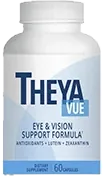
We keep this to seven checks you can run on any eye vitamin. We use the one big trial the whole category leans on, and we compare a real bottle with it. The bottle is TheyaVue, but the checks fit any product that supports eye health.
A gentle warning first. Any page that promises sharper sight from a capsule is promising more than the research does.
- AREDS2 enrolled 4,203 people aged 50 to 85 who already had intermediate or advanced age-related macular degeneration.
- It slowed progression in that group. It did not sharpen vision, and it showed no benefit for early or no disease.
- Adding omega-3 fatty acids showed no extra benefit for progression, with a hazard ratio of 1.01.
- TheyaVue matches only the copper amount of the AREDS2 formula, and it publishes no lutein or zeaxanthin amount.
- No dedicated clinical trial of TheyaVue itself was located.
Want to compare a real eye vitamin label against these checks? The order page shows the TheyaVue kits and the 60-day terms.
See today's price and guaranteeMytheyavue earns money when you buy through the order links on this site.
This page describes research. It is not advice to start, stop or change any supplement. TheyaVue is a dietary supplement, not FDA approved, and not a treatment for any eye disease. A sudden change in your sight means an eye doctor the same day.
Check 1: Who was tested?
The first question for any eye vitamin claim is the people in the study. The National Eye Institute, which is part of the National Institutes of Health, ran AREDS2. It was a large, randomized, double-blind, placebo-controlled trial.
It enrolled 4,203 people aged 50 to 85. Every one of them already had intermediate age-related macular degeneration in both eyes, or advanced disease in one eye with intermediate or worse in the other. Nobody with healthy eyes was in the trial. Nobody with only early disease was in it either.
So the finding applies to a defined group. If you are outside that group, the trial does not speak for you. That is not a flaw in the trial. It is the reason to read the claim carefully.
Check 2: What did it measure?
AREDS2 measured how quickly people progressed to advanced macular degeneration. It followed participants for about five years. Swapping lutein and zeaxanthin in for the beta-carotene of the original formula was found to work at least as well, with a lower lung cancer risk in former smokers.
The earlier AREDS core formula was described by the National Eye Institute as cutting progression to advanced disease by roughly 25 percent over five years in people at that stage. That is a real result from a well-run trial. It deserves to be stated accurately and not inflated.
Notice the verb. The formula slowed a disease. It did not sharpen print, fix glare or restore what was lost.
Check 3: Can eye vitamins improve vision?
Not in that trial. The research does not show sharper sight from the formula. That answers a long list of searches in one go: can eye vitamins improve vision, do eye vitamins improve eyesight, can vitamins improve eyesight, do vitamins for eyes really work.
- It did not sharpen anyone's vision. Slowing progression is not reversing it.
- No benefit appeared in people with only early disease.
- It showed no benefit for people with no disease, and it was never tested as a prevention formula.
- It did not restore vision already lost.
- Omega-3 fatty acids added no measurable benefit to progression.
Blurred sight has causes, such as a refractive error, a cataract or a retinal condition. Each cause has its own real care. A vitamin is not one of them.
Check 4: Does your bottle match the trial formula?
A label that mentions the trial does not automatically match it. Find the six AREDS2 nutrients on the label you hold, and compare the amounts. Then look at who the label is talking to.
| Nutrient | AREDS2 a day | TheyaVue a day |
|---|---|---|
| Vitamin C | 500 mg | 200 mg |
| Vitamin E | 400 IU (about 180 mg) | 20 mg (about 44 IU) |
| Lutein | 10 mg | Inside a 481 mg blend, not published |
| Zeaxanthin | 2 mg | Inside a 481 mg blend, not published |
| Zinc | 80 mg, or 25 mg in the lower-zinc arm | 32 mg |
| Copper | 2 mg | 2 mg |
Only the copper matches. That does not make the bottle unsafe. It means the trial result describes a different formula. A resemblance is not a replication.
Check 5: What evidence backs the other ingredients?
Many eye vitamins add plants and extras that the trial never tested. TheyaVue's blend holds ten. The evidence for each, from the ingredient research on this site, is thin to moderate.
| Ingredient | Human evidence level | Short note |
|---|---|---|
| Lutein and zeaxanthin | Moderate | Research doses of 10 mg and 2 mg in AREDS2; amounts here not published |
| Bilberry extract | Weak | No rigorous evidence for normal night vision |
| Alpha lipoic acid | Limited | 600 mg a day did not prevent diabetic macular edema in one trial |
| Eyebright | Weak | The only trial found used homeopathic drops, not a capsule |
| Quercetin | Limited | No human eye-disease trial of oral quercetin found in a 2017 review |
| Rutin | Weak | Main human report dates from 1948, with no placebo control |
| L-taurine | Limited | Human safety data up to 3 g a day; protection shown mainly in animal and cell studies |
| Grape seed extract | Limited | One 12-month trial at 150 mg a day in diabetic retinopathy |
| Lycopene | Weak | Mostly links between intake and eye outcomes, not dosing trials |
Support for a plant in the lab is not the same as proof that a capsule helps a person.
Check 6: Has the finished product been tested?
No dedicated clinical trial of TheyaVue itself was located. Every study cited on this site tests an ingredient or a different formula. No study tested a 481 mg blend of ten ingredients mixed in unknown proportions.
That is not unusual for a supplement. It is worth saying plainly all the same. Research behind an ingredient is not research behind a product.
Check 7: What can really measure your eyes?
An eye doctor has instruments that a feeling cannot match: a visual acuity chart, a tonometer for eye pressure, a dilated look at the retina and, in some clinics, a scan of the macula. They measure the same way twice.
If you want to know whether any eye vitamin is doing something for you, the exam is the test. Ask your eye doctor which ones suit your eyes, and put your next visit in the calendar before you start. Are eye vitamins worth taking? For some people with a diagnosed condition, a doctor may say yes. For a healthy eye, the case is weaker.
Frequently asked questions
Do eye vitamins work?
Some do something narrow. AREDS2 found its formula slowed progression of intermediate or advanced macular degeneration. It showed no benefit for early or no disease.
Can eye vitamins improve vision?
No trial shows sharper sight from the AREDS2 formula. It slowed disease progression and did not restore or sharpen vision.
Are eye vitamins worth taking?
That depends on your eyes and your doctor's advice. The strongest evidence is for people with intermediate or advanced macular degeneration.
What are eye vitamins?
They are supplements sold to support eye health, often with vitamins C and E, zinc, copper, lutein and zeaxanthin. Formulas and amounts vary a great deal.
Do eye supplements work for healthy eyes?
AREDS2 showed no benefit for people with early or no macular degeneration. A label that implies benefit for healthy eyes goes past the trial.
Does TheyaVue match the AREDS2 formula?
Only on copper. Its vitamin C, vitamin E and zinc are lower, and its lutein and zeaxanthin amounts are not published.
Which sources back this page?
- AREDS2 Research Group (2013). Lutein + Zeaxanthin and Omega-3 Fatty Acids for Age-Related Macular Degeneration: the AREDS2 Randomized Clinical Trial. JAMA.
- AREDS2 Research Group (2022). Long-term Outcomes of Adding Lutein/Zeaxanthin and omega-3 Fatty Acids to the AREDS Supplements on AMD Progression (Report 28). JAMA Ophthalmology.
- National Eye Institute (2025). About AREDS and AREDS2.
- National Eye Institute (2013). NIH study provides clarity on supplements for protection against blinding eye disease.
- Canter PH, Ernst E (2004). Anthocyanosides of Vaccinium myrtillus (Bilberry) for Night Vision: A Systematic Review of Placebo-Controlled Trials. Survey of Ophthalmology.
- Haritoglou C et al. (2011). Alpha-Lipoic Acid for the Prevention of Diabetic Macular Edema. Ophthalmologica.
- McKay TB, Karamichos D (2017). Quercetin and the Ocular Surface: What We Know and Where We Are Going. Experimental Biology and Medicine.
- Levitt LM et al. (1948). Rutin Therapy for Increased Capillary Fragility and Retinopathy Associated with Diabetes Mellitus. The American Journal of the Medical Sciences.
- Duan H et al. (2023). Taurine: A Source and Application for the Relief of Visual Fatigue. Nutrients.
- Moon SW et al. (2019). Effect of Grape Seed Proanthocyanidin Extract on Hard Exudates in Patients with Non-Proliferative Diabetic Retinopathy. Medicine.
- Shafe MO et al. (2024). Lycopene: A Potent Antioxidant with Multiple Health Benefits. Journal of Nutrition and Metabolism.
- Stoss M et al. (2000). Prospective Cohort Trial of Euphrasia Single-Dose Eye Drops in Conjunctivitis. The Journal of Alternative and Complementary Medicine.
- AREDS2 explained (this site)
- What TheyaVue's ingredients are studied for (this site)
- TheyaVue ingredients page (this site)
Our view
Eye vitamins can have a job, and the job is narrow. For a person with the kind of macular degeneration AREDS2 studied, a doctor may point to that trial. For everyone else, the research is weaker, and the claim of sharper sight has no support at all.
TheyaVue sits beside that research, not inside it. It shares some ingredient names with the trial formula, it matches the copper, and it leaves out the lutein and zeaxanthin amounts that would let anyone compare it. We would not take it as a stand-in for an eye exam, and we would ask an eye doctor first.
Orders through our links earn us a commission. The trial says what it says whether you buy or not.
If you want to see the label and the kit options after reading the evidence, the order page lists them with the 60-day terms.
See today's price and guaranteeMytheyavue earns money when you buy through the order links on this site.